

The Integrative Cardiologist · By Sameer Azhak, MD, FACC
At a Glance
Sleep apnea can contribute to high blood pressure, particularly when pressure stays elevated at night or remains difficult to control despite treatment.¹ ²
You do not have to feel sleepy—or remember waking—to have it.² ³
Morning readings, snoring, witnessed breathing pauses, and your broader medical history can prompt a sleep evaluation. None diagnoses sleep apnea on its own.¹ ² ³
CPAP can improve breathing, symptoms, and blood-pressure control. The average BP reduction is modest, and many people still need medication.¹
Treatment can include airway support, weight management when appropriate, and selected medicines or devices. Do not stop CPAP or blood-pressure treatment without reassessment.
The preoperative visit that became a sleep conversation
He came to me before shoulder surgery. He was 54, worked at a desk, and had torn his left rotator cuff playing catch with his son. He was 5 feet 10 inches tall and weighed 320 pounds.
His office blood pressure looked reassuring: 130/80 mm Hg. He was taking olmesartan 20 mg, chlorthalidone 25 mg, and nebivolol 10 mg.
It would have been easy to focus on that number and move on.
But his heart scan raised questions. His heart pumped normally, with an ejection fraction of 65%, yet the muscle wall was mildly thickened. His aortic root—the beginning of the body’s main artery—measured 4.3 centimeters, and the estimated pressure in his lung arteries was elevated.
Those findings did not diagnose sleep apnea. They made one office reading an incomplete account of his cardiovascular history.
His home journal added the contrast. Evening readings averaged about 128/75. Morning readings ran 150 to 160 over 90.
That pattern made me ask what was happening while he slept.
The shoulder observation
In my practice, I often see shoulder problems alongside obesity and previously unrecognized sleep apnea. That has made me curious about sleeping position.
Some people with sleep apnea breathe worse on their backs.⁴ I wonder whether years of favoring the side could contribute to shoulder symptoms in some patients.
That is a clinical observation and a question worth studying—not an established cause of rotator cuff tears. In this patient’s case, the reported injury occurred while playing catch; I would not attribute his tear to sleep apnea.
Researchers have examined sleep position in relation to shoulder pain and rotator cuff tendinopathy, and others have studied surgical complications in patients who already have sleep apnea and rotator cuff disease. These studies do not establish the pathway I am describing.⁵ ⁶
A shoulder injury does not diagnose sleep apnea. In the right context, it can prompt another question: “How do you sleep?”
Why this story matters to you
If your blood pressure stays high despite medication—or your morning readings tell a different story from the office—sleep belongs in the conversation.
The 2025 American Heart Association and American College of Cardiology guideline estimates that obstructive sleep apnea is present in 25% to 50% of people with hypertension.¹
Here is how a breathing problem at night can become a pressure problem during the day, how we investigate it, and what treatment can change.
What obstructive sleep apnea actually is
Picture the back of your throat as a soft, flexible tube. While you are awake, surrounding muscles help hold it open. During sleep, those muscles relax. In obstructive sleep apnea, the airway repeatedly narrows or closes.
A partial closure reduces airflow. A complete closure stops it, even while your chest and belly keep trying to pull air in. These episodes can lower oxygen, activate the nervous system, and break up sleep—many times an hour.²
In this article, “sleep apnea” means the obstructive kind.
Why you may not know
You can have repeated breathing interruptions and remember none of them. Your brain briefly rouses you enough to reopen the airway, often without a waking memory.
Feeling as if you slept through the night does not prove that you breathed normally.
Snoring is a clue, not a diagnosis
Snoring is the sound of air moving through a narrowed airway. Many people snore without sleep apnea, and some people with sleep apnea barely snore.
Symptoms and risk factors tell us when to investigate. An appropriate evaluation and sleep test establish the diagnosis.³
How disrupted breathing raises pressure
Follow one episode:
Your airway narrows or closes. Breathing muscles keep working, but air does not move freely.
Oxygen may fall while breathing effort rises. Your chest pulls harder against the obstruction.
Your brain responds. You rouse enough to reopen the airway.
The fight-or-flight system activates. Blood vessels tighten, and heart rate and pressure can surge.
You return to sleep. The cycle may repeat minutes—or seconds—later.²
The problem is not just interrupted sleep. It is what your body repeatedly does to get you breathing again.
There is mechanical stress too. Trying to inhale against a closed airway creates large pressure swings inside your chest, changing the forces acting on your heart and blood vessels.²
Over time, repeated alarms can contribute to persistent sympathetic activation and high blood pressure, including during waking hours.¹ ²
The missing nighttime dip
Blood pressure usually falls during sleep. Clinicians call this “dipping.” Sleep apnea can disrupt that pattern, and nighttime hypertension can be missed by ordinary office checks.¹
But morning and evening home readings cannot tell us exactly what happened overnight.
My patient’s high morning readings raised suspicion. They did not prove that his pressure failed to dip. A 24-hour ambulatory blood-pressure monitor could answer that question, while a sleep evaluation could assess whether breathing interruptions were contributing.
When sleep apnea moves higher on my list
What you or your partner may notice
Habitual loud snoring.
Pauses in breathing, often followed by a snort or gasp.
Waking with choking or gasping.
Unrefreshing sleep or morning headaches.
Daytime sleepiness or difficulty staying asleep.
A partner may notice the breathing changes before you do.
What your medical history may show
Obesity, a large neck, a crowded airway, and difficult-to-control hypertension raise suspicion. So does a 24-hour monitor showing elevated nighttime pressure or loss of the normal dip.¹
People of every size can have sleep apnea. A larger body is not a diagnosis, and the absence of sleepiness does not rule it out.² ³
When the heart scan adds a question
A thickened heart muscle or enlarged aorta may reflect years of pressure exposure. Studies have also found a small association between sleep apnea and a larger thoracic aorta, but the evidence is limited.⁷
When these findings accompany reassuring office readings, I look beyond the office. They are reasons to investigate—not proof of the cause.
An elevated estimate of lung-artery pressure deserves its own assessment. Sleep-disordered breathing may be relevant, but heart disease, lung disease, and underbreathing can also contribute. Isolated obstructive sleep apnea does not usually explain pulmonary hypertension by itself.⁸
You do not need to sort out those possibilities yourself. The point is to avoid assuming that one reassuring cuff reading answers every question.
What “resistant hypertension” means
Blood pressure is considered resistant when it remains above goal despite three complementary medicines, including a diuretic, at the highest tolerated doses—or when control requires four or more medicines.¹
Taking three medicines does not establish resistance by itself. Before using that label, I check measurement technique, out-of-office readings, medication use, and substances that may raise pressure. Then we investigate contributors such as sleep apnea, excess aldosterone, and kidney-related conditions.¹
My patient’s morning readings needed attention. His visit alone did not establish resistant hypertension.
How we find out
Do you have to sleep in a laboratory?
Not always.
A clinician-ordered home sleep apnea test uses a device you wear in your own bed. For selected adults without major complicating conditions who appear likely to have moderate to severe OSA, a technically adequate home test can establish the diagnosis.³ ⁹
An overnight laboratory study, called polysomnography, records more information, including brain waves, sleep stages, breathing, oxygen, and heart rhythm.
Your clinician may recommend the laboratory if you have significant heart or lung disease, suspected underbreathing, prior stroke, chronic opioid use, severe insomnia, or certain neuromuscular conditions.³
The choice depends on the question we need the test to answer—not simply which test is more convenient.
A negative home test may need follow-up
A home test can miss sleep apnea. If it is negative, inconclusive, or technically inadequate, a laboratory study may be the next step.³
Questionnaires, overnight oxygen recordings, and watch alerts can raise suspicion. They are not interchangeable with a diagnostic sleep evaluation.³
If surgery is coming up
Tell your surgeon and anesthesiologist if you snore, stop breathing during sleep, have suspected sleep apnea, or use CPAP. The team can plan appropriate monitoring and precautions.¹⁰
A preoperative visit can uncover a problem worth addressing even when it was not the reason you made the appointment.
What CPAP can—and cannot—do
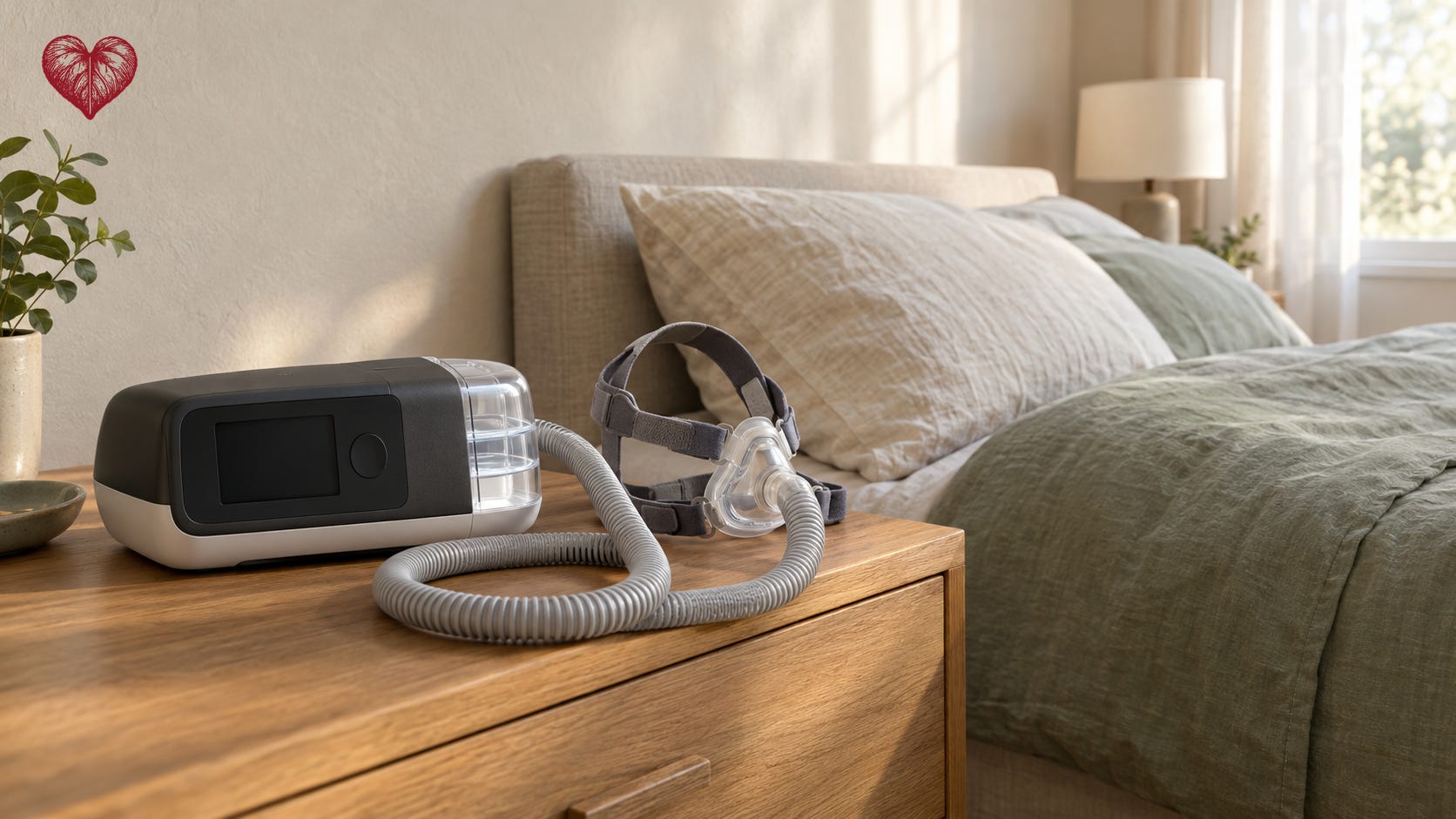
CPAP means continuous positive airway pressure. A bedside machine sends air through a mask, helping hold your airway open while you sleep.
Its first job is to treat the breathing obstruction.
The next question is usually: “Will I still need blood-pressure medicine?”
For most people, yes.
The 2025 guideline summarizes randomized trials showing average reductions of about 2 to 5 mm Hg in office or ambulatory blood pressure with short-term CPAP. Individual responses vary.¹
What HIPARCO showed
In HIPARCO, researchers at 24 Spanish hospitals randomized 194 patients with sleep apnea and resistant hypertension to CPAP or no CPAP for 12 weeks. Everyone continued usual blood-pressure medication.¹¹
Compared with the control group, CPAP produced an additional reduction of 3.1 mm Hg in 24-hour mean pressure and 3.2 mm Hg in diastolic pressure. The systolic difference did not reach statistical significance. CPAP also improved the nighttime dipping pattern.¹¹
This was not a cure for hypertension. It was an additional benefit alongside medication.
What longer follow-up suggested
HIPARCO-2 followed 161 patients for a median of about five years. It compared people who used CPAP consistently with a comparison group who did not; it was observational, not a new randomized trial.¹²
Consistent users had more favorable blood-pressure changes, particularly at night, and used an average of 1.1 fewer blood-pressure medicines. More nightly use was associated with greater systolic improvement.¹²
Those findings are encouraging, but they do not prove that CPAP alone caused the differences. The overall systolic estimate was uncertain, and people who use treatment consistently may differ in other ways.
For you, the practical lesson is simple: use treatment consistently, then reassess rather than guess.
Do not stop blood-pressure medicine because you have started CPAP. If readings improve, your clinician can decide whether the regimen can be simplified while preserving control and any other benefits of your medicines.
What about heart attacks and strokes?
CPAP treats airway obstruction and can improve symptoms and blood-pressure control. Randomized trials have not consistently demonstrated fewer cardiovascular events or deaths in the populations studied.¹
I would not promise that the mask prevents a heart attack. I also would not use that uncertainty as a reason to leave clinically important sleep apnea untreated.
If the mask is difficult
Struggling with CPAP is not a personal failure.
Tell your sleep clinician. Mask fit, pressure settings, humidity, nasal symptoms, and the overall approach may need adjustment. A machine sitting unused cannot deliver the benefit we are trying to achieve.
Treat the whole problem
Airway treatment, weight management when appropriate, and blood-pressure medication are not competing choices.
Extra tissue around the airway and changes in lung volume can contribute to OSA in people with obesity.¹³ The AHA recommends considering behavioral changes and weight management as part of treatment when appropriate.²
A meta-analysis found that combining weight-loss interventions with CPAP lowered systolic blood pressure more than CPAP alone. Adding CPAP to weight loss alone did not produce a statistically significant additional blood-pressure reduction.¹⁴
This is not an instruction to lose weight before receiving airway treatment. It is a reason to address both when both matter.
An FDA-approved medication option
On December 20, 2024, the FDA approved tirzepatide, sold as Zepbound, for moderate to severe OSA in adults with obesity, alongside a reduced-calorie diet and increased physical activity. It was the first medication approved for this indication.¹⁵
The approval drew on two trials involving 469 adults without type 2 diabetes: one trial included PAP users, while the other included people unable or unwilling to use PAP.¹⁵ ¹⁶
After 52 weeks, breathing interruptions fell by about 25 to 29 events per hour with tirzepatide, compared with about 5 with placebo. Participants also lost substantial weight.¹⁶
The 2025 guideline reports additional systolic reductions versus placebo of 7.6 mm Hg in the trial without PAP use and 3.7 mm Hg in the trial with PAP use.¹
Tirzepatide is an option for a defined group, not a universal treatment. It can cause gastrointestinal adverse effects and should not be used with a personal or family history of medullary thyroid cancer or multiple endocrine neoplasia type 2. Other warnings and medication considerations also matter.¹⁵
Whether it fits your situation depends on your history, tolerability, access, and goals. Improvement or weight loss does not automatically mean you can stop CPAP; that requires reassessment.
Other approaches
A custom oral appliance may be an option for selected patients, including some who cannot tolerate CPAP. Selected patients may also qualify for other airway treatments or implanted nerve-stimulation devices. These options require individualized assessment, and their blood-pressure benefits should not be assumed to match CPAP’s.¹ ²
An investigational nightly pill, AD109, is also under FDA review. According to the manufacturer’s announcement, the agency assigned a target decision date of February 28, 2027. That is a review deadline—not a promise of approval. AD109 is not an approved treatment as of this article’s October 13, 2026 preparation.¹⁷
You do not have to wait for a future drug to investigate a breathing problem you may have now.
What to bring to your appointment
You do not need to diagnose yourself. Bring observations that help us ask better questions:
“My partner says I snore or stop breathing.”
“My pressure is still high on medication.”
“My readings are highest in the morning.”
“My 24-hour monitor showed high pressure at night.”
“I wake whenever I roll onto my back.”
“I have shoulder discomfort and sleep mostly on one side.”
“My heart scan raised questions despite reassuring office readings.”
“I have CPAP, but I am struggling to use it.”
“When will we reassess my pressure after treatment?”
Bring the numbers
Bring a week or two of home readings, including morning measurements, and note medication timing.
If you use CPAP, bring its report of nightly use and remaining breathing events. Those data add context that one office reading cannot provide.
Make follow-up part of the plan
After treatment starts, agree on when to reassess symptoms and home or ambulatory pressure. If your readings improve, we can review the medication plan. If they do not, we keep looking. Sleep apnea can be one contributor among several.¹
And if you have stopped using CPAP, say so. That information is more useful than a polite silence.
The lesson to keep
If your blood pressure is difficult to control—or morning readings tell a different story from the office—ask about sleep.
A clinical observation can open a question. It does not need to become a diagnosis before we investigate it.
Finding sleep apnea gives us another part of the problem to treat. Good blood-pressure care continues after the sleep study, the mask fitting, or the first improved reading.
This post is for general educational purposes only. It is not medical advice, is not a substitute for care from your own physician, and does not create a physician-patient relationship. Do not start, stop, or change any treatment based on what you read here. If you think you may have a medical emergency, call 911 or go to the nearest emergency department.
Free resource: Download my Lowering Blood Pressure guide (PDF).
Also by Dr. Azhak: Lower Your Blood Pressure: Help Your Doctor Reduce Your Medication, by Sameer Azhak, MD, FACC. Available now in paperback and on Kindle. Buy the paperback · Read on Kindle.
© 2026 Cordate Press
References
Jones DW, Ferdinand KC, Taler SJ, et al. 2025 guideline for the prevention, detection, evaluation and management of high blood pressure in adults. Hypertension. 2025. doi:10.1161/HYP.0000000000000249. Hypertension guideline
Yeghiazarians Y, Jneid H, Tietjens JR, et al. Obstructive Sleep Apnea and Cardiovascular Disease: A Scientific Statement From the American Heart Association. Circulation. 2021;144:e56–e67. doi:10.1161/CIR.0000000000000988. AHA scientific statement
Kapur VK, Auckley DH, Chowdhuri S, et al. Clinical practice guideline for diagnostic testing for adult obstructive sleep apnea. J Clin Sleep Med. 2017;13:479–504. doi:10.5664/jcsm.6506. AASM diagnostic guideline
Jereisat RA, Qaryouti H, Alsawalha H, et al. The Effect of Different Sleep Positions on the Severity of Obstructive Sleep Apnea: A Retrospective Study. Nat Sci Sleep. 2026;18. doi:10.2147/NSS.S627693. Sleep-position study
Holdaway LA, Hegmann KT, Thiese MS, Kapellusch J. Is sleep position associated with glenohumeral shoulder pain and rotator cuff tendinopathy: a cross-sectional study. BMC Musculoskelet Disord. 2018;19:408. doi:10.1186/s12891-018-2319-9. Full text
Cancienne JM, Brockmeier SF, Deasey MJ, Werner BC. Obstructive Sleep Apnea and Arthroscopic Rotator Cuff Repair—Are Complication Rates Really Increased? J Am Acad Orthop Surg. 2019;27:486–492. doi:10.5435/JAAOS-D-18-00069. Rotator-cuff surgery study
Gherbesi E, Tadic M, Faggiano A, et al. Sleep Apnea Syndrome and Large Artery Subclinical Damage: Targeting Thoracic Aortic Dilatation. Am J Hypertens. 2022;35:543–550. doi:10.1093/ajh/hpac006. Aortic-dilatation study
2022 ESC/ERS Guidelines for the diagnosis and treatment of pulmonary hypertension. Eur Respir J. 2023;61:2200879. Pulmonary-hypertension guideline
American Academy of Sleep Medicine. AASM publishes new guideline for diagnostic testing for adult sleep apnea. AASM guideline announcement
Chung F, Memtsoudis SG, Ramachandran SK, et al. Society of Anesthesia and Sleep Medicine Guidelines on Preoperative Screening and Assessment of Adult Patients With Obstructive Sleep Apnea. Anesth Analg. 2016;123:452–473. doi:10.1213/ANE.0000000000001416. Preoperative guideline
Martínez-García MA, Capote F, Campos-Rodríguez F, et al. Effect of CPAP on blood pressure in patients with obstructive sleep apnea and resistant hypertension: the HIPARCO randomized clinical trial. JAMA. 2013;310:2407–2415. doi:10.1001/jama.2013.281250. HIPARCO trial
Navarro-Soriano C, Torres G, Barbé F, et al. The HIPARCO-2 study: long-term effect of continuous positive airway pressure on blood pressure in patients with resistant hypertension: a multicenter prospective study. J Hypertens. 2021;39:302–309. doi:10.1097/HJH.0000000000002664. HIPARCO-2 study
Patil SP, Schneider H, Schwartz AR, Smith PL. Adult Obstructive Sleep Apnea: Pathophysiology and Diagnosis. Chest. 2007;132(1):325–337. doi:10.1378/chest.07-0040. Full text
Kovács DK, Gede N, Szabó L, et al. Weight reduction added to CPAP decreases blood pressure and triglyceride level in OSA: Systematic review and meta-analysis. Clin Transl Sci. 2022;15(5):1238–1248. doi:10.1111/cts.13241. Weight-loss and CPAP meta-analysis
U.S. Food and Drug Administration. FDA Approves First Medication for Obstructive Sleep Apnea. December 20, 2024. FDA approval announcement
Malhotra A, Grunstein RR, Fietze I, et al. Tirzepatide for the Treatment of Obstructive Sleep Apnea and Obesity. N Engl J Med. 2024;391:1193–1205. doi:10.1056/NEJMoa2404881. SURMOUNT-OSA trials
Apnimed. Apnimed Announces FDA Acceptance of New Drug Application for AD109, An Investigational Oral Pill to Treat Adults with Obstructive Sleep Apnea. July 14, 2026. Manufacturer announcement. Manufacturer announcement