

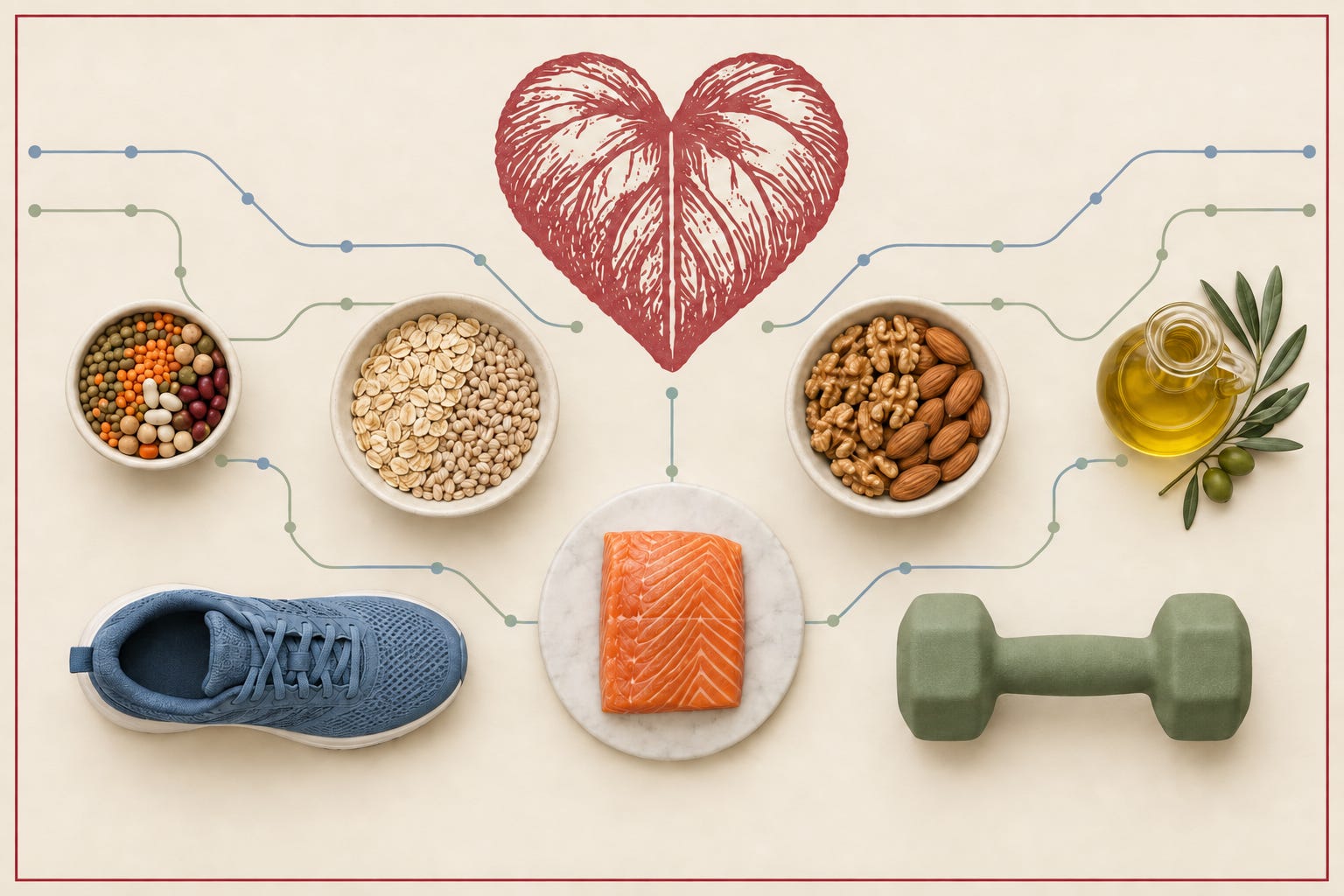
The Short Version
Most lifestyle changes work through two broad pathways: they lower the number of ApoB-containing particles circulating, or they help the liver clear LDL more effectively. The changes are usually gradual, but they accumulate over time.
Soluble fiber is one of the more dependable dietary tools for modest LDL lowering. Oats, beans, lentils, psyllium, chia, and barley help alter bile-acid recycling in the gut.
Saturated fat matters, but replacement matters just as much. Swapping butter, fatty meat, or coconut oil for olive oil, nuts, seeds, and high-fiber foods is different from replacing them with white flour and sugar.
Fish belongs in a heart-healthy pattern. Fish-oil supplements mainly affect triglycerides and should not be mistaken for LDL-lowering treatment.
“Anti-inflammatory eating” is less a special diet than a familiar food pattern: plants, legumes, olive oil, nuts, fish, minimally processed food, and fewer sugary drinks and refined starches.
Fasting is useful for some people because it creates structure around eating. Its benefits depend much more on the overall pattern than on the length of the eating window.
Exercise improves cardiovascular health in ways the lipid panel does not fully capture. Aerobic work is especially useful for fitness, triglycerides, and blood pressure; strength work protects muscle, insulin sensitivity, and body composition.
A Quick Recap
In Part 1, we laid down the basic map. Cholesterol moves through the bloodstream inside particles called lipoproteins — a fleet of vehicles, each carrying an identifying tag called an apolipoprotein. Most of the particles relevant to atherosclerosis carry ApoB: VLDL and its remnants, IDL, LDL, and Lp(a).
The central prevention question is simple: how many of these particles are circulating, how long do they remain in the bloodstream, and how likely are they to enter and remain in artery walls?
Most cholesterol-lowering interventions work through one of two broad pathways. They either reduce the number of atherogenic particles in circulation, or they improve LDL clearance by the liver.
This article is about the parts of that system you can influence without a prescription.
What Food Can Change
Food does not affect cholesterol through one pathway. Different dietary choices can influence cholesterol absorption, bile-acid recycling, triglyceride production, insulin resistance, liver fat, LDL clearance, body weight, and the overall number of ApoB-containing particles circulating in the blood.
The effect of one meal is small. The dietary pattern repeated over months and years is what matters.
Soluble Fiber and LDL
Soluble fiber is the gel-forming fiber found in oats, barley, beans, lentils, psyllium, chia, flaxseed, apples, berries, and citrus. The best-studied forms are beta-glucan from oats and barley and psyllium husk.
Your liver uses cholesterol to make bile acids, which help digest fat. Most bile acids are normally reabsorbed in the intestine and returned to the liver for reuse. Soluble fiber partly interrupts that recycling. The liver, needing more bile, has to open more LDL depot stations to pull cholesterol out of circulation (Bakr & Farag, ACS Omega). Over time, that can help lower circulating LDL-C.
It is a modest effect, not a miracle. But it is one of the more dependable food-based ways to move LDL in the right direction. It works especially well as part of an eating pattern that also includes less saturated fat and more minimally processed food.
A practical goal is to add about 5 to 10 grams of soluble fiber daily, gradually, within an overall high-fiber diet. A cup of cooked oatmeal provides roughly 2 grams. A tablespoon of psyllium provides about 2 to 3 grams, depending on the product.
Start slowly. Fiber works best when your gut has time to adapt. Drink enough water, and ask your pharmacist how far apart to take psyllium from prescription medications.
Refined Carbohydrates and Triglycerides
Refined grains, added sugar, and sugary drinks do not affect every person the same way. But in the setting of insulin resistance, excess calorie intake, diabetes, or central weight gain, they can raise triglycerides and push the liver to send out more triglyceride-carrying VLDL particles (Siri-Tarino et al., AJCN).
That pattern often travels with lower HDL-C, higher triglycerides, and smaller, denser LDL particles.
Small LDL is not automatically dangerous, and large LDL is not automatically safe. The more useful question remains: how many ApoB-containing particles are circulating, and what is driving that number?
A reasonable rule of thumb is to choose intact whole grains more often than flour-based foods, eat beans and lentils regularly, and make sweetened drinks occasional rather than routine.
White bread, sweet coffee drinks, soda, juice, many snack foods, and desserts can all fit into a life. They simply work better as occasional food than as the foundation of a daily pattern.
Fish and Omega-3s
Fish and omega-3 fats are mostly a triglyceride story.
EPA and DHA, the long-chain omega-3 fats found in fatty fish, can reduce the liver’s production of triglyceride-rich particles and improve triglyceride clearance (Rimm et al., Circulation). The most consistent measurable effect is lower triglycerides.
LDL-C may go up, down, or stay the same with omega-3 products. That is one reason fish oil is not a primary LDL-lowering therapy. If LDL-C rises after starting a fish-oil supplement, it is worth reviewing LDL-C, non–HDL-C, and ApoB with your clinician rather than making assumptions based on LDL particle size alone.
For most people, fish twice a week is a useful default. Salmon, sardines, mackerel, herring, anchovies, and trout are all reasonable choices. The easiest version matters most: sardines on toast, salmon from the freezer, or grilled fish when you are out.
Fish on the plate and fish oil in a bottle are not interchangeable. Prescription omega-3 therapy has a role for selected patients with high triglycerides (Wilson et al., Circulation). Ordinary over-the-counter fish-oil supplements vary widely in dose, formulation, purity, and evidence. Part 3 will cover that distinction in more detail.
The Fat-Quality Question
The question I hear less often now is, “Should I avoid fat?”
The better question is: what kind of fat am I eating, and what is it replacing?
Saturated fat is concentrated in fatty cuts of meat, butter, full-fat dairy, coconut oil, and palm oil. For many people, a diet high in saturated fat raises LDL-C partly by reducing LDL-receptor activity in the liver (Feingold, Endotext). Trans fats remain worth avoiding altogether — they raise LDL-C and lower HDL-C.
The useful everyday change is to replace saturated fats with unsaturated fats: olive oil, avocado, nuts, seeds, walnuts, and fish. That substitution generally improves LDL-related measures. Replacing saturated fat with white flour, refined starch, or added sugar is a much less useful trade.
Coconut and palm oils are plant-derived, but that does not tell you enough about their effect on LDL-C. They are relatively high in saturated fat and generally raise LDL-C more than oils rich in unsaturated fat (Sacks et al., AHA Presidential Advisory, Circulation).
Keep olive oil close at hand. Make nuts and seeds routine rather than aspirational. Use butter, cream, and cheese deliberately, rather than automatically.
Plant-Forward Protein and Red Meat
The anti-inflammatory eating pattern I describe in my own book is not a proprietary diet. It is a practical version of the overlap between Mediterranean eating, DASH-style eating, and a mostly plant-forward plate.
It emphasizes beans, lentils, chickpeas, tofu, tempeh, nuts, seeds, vegetables, fruit, intact grains, olive oil, and fish. These foods help because they bring fiber, unsaturated fats, plant sterols, minerals, and better blood-sugar control. They also tend to crowd out foods that make LDL-C, triglycerides, and calorie balance harder to manage.
Deeply colored plants, extra-virgin olive oil, tea, coffee, cocoa, berries, and leafy greens contain polyphenols. These compounds may influence oxidative and inflammatory pathways, but the strongest reason to eat these foods is less glamorous: they make it easier to build a diet around foods that improve the overall metabolic picture.
A fair word about red meat: both unprocessed and processed red meats are associated with cardiometabolic risk, and the T2D signal for processed meat specifically is especially consistent across large cohort studies (Qian et al., Diabetes Care). Bacon, sausage, deli meat, hot dogs, and many cured meats belong in the uncommon category for most people.
Unprocessed red meat is a different conversation. A moderate portion of steak or lamb inside a fiber-rich, plant-forward pattern is not usually the main cardiovascular issue I see in the office. More often, the problem is a pattern built around refined carbohydrates, ultra-processed food, processed meat, sweetened drinks, and too few plants.
For many patients, the highest-yield change is not eliminating one food. It is making recognizable, minimally processed food the default again.
A Note on Fasting
Fasting is a topic where the enthusiasm often runs ahead of the evidence.
Time-restricted eating can help some people reduce late-night eating, simplify decisions around food, lose weight, or improve blood sugar. Those changes may improve triglycerides. LDL-C may improve, stay unchanged, or occasionally rise depending on the dietary pattern, amount of weight change, and individual biology (Gabel et al., Curr Atheroscler Rep).
Supervised prolonged-fasting programs have reported reductions in triglycerides, VLDL, and LDL, along with an increase in large HDL particles suggesting improved lipoprotein-associated atherogenic risk (Grundler et al., Eur J Nutr). But those studies do not mean prolonged fasting is a general treatment for high cholesterol, and they do not replace the value of a durable eating pattern.
Fasting is optional.
If it fits your life, helps you stop late-night snacking, and makes food choices easier, it can be a reasonable tool. If it worsens sleep, mood, hot flashes, hunger, binge-and-restrict behavior, or your ability to eat enough protein, it is not helping.
Most adults already have a natural overnight interval of roughly 12 hours between dinner and breakfast. That is a perfectly reasonable place to begin.
Fasting is a poor fit for people taking insulin or sulfonylureas, anyone who is pregnant or breastfeeding, anyone with an active or prior eating disorder, and anyone who develops binge-and-restrict cycles. If you have diabetes, kidney disease, liver disease, gout, or another complex medical condition, discuss fasting with your clinician before trying it.
What Exercise Changes
Exercise is the most under-prescribed cardiovascular therapy I know of.
It affects triglycerides, blood pressure, insulin sensitivity, fitness, body composition, sleep, mood, and vascular function — many of which matter even when LDL-C barely moves.
When muscles contract, they use more fuel. Regular activity improves the way the body clears triglyceride-rich particles from circulation and improves insulin sensitivity in muscle. That is why triglycerides are often the most responsive lipid measurement when someone becomes more active.
The larger point is that exercise changes cardiovascular risk through pathways that diet alone cannot reproduce.
Move Often
The foundation is movement you can repeat: walking, cycling, swimming, hiking, dancing, gardening, or anything else that gets you out of a chair and raises your heart rate.
Low-intensity movement may have a modest effect on the lipid panel, but it still matters because it displaces sedentary time and supports blood pressure, blood sugar, mood, mobility, and long-term function.
For most adults, the right starting point is not a fitness test. It is adding movement that feels realistic enough to continue next month.
Build Aerobic Fitness
For most adults, the familiar target remains 150 to 300 minutes a week of moderate aerobic activity, 75 to 150 minutes of vigorous activity, or a combination (Arnett et al., Circulation).
Moderate activity means your breathing and heart rate rise, but you can still speak in short sentences. Brisk walking, comfortable cycling, active gardening, recreational swimming, and moderate hiking all count.
Vigorous activity means conversation is difficult. Running, fast cycling, lap swimming, steep hiking, singles tennis, and hard rowing are examples.
Aerobic exercise tends to improve triglycerides most consistently. HDL-C may rise slightly. LDL-C can improve modestly, especially when exercise is paired with dietary improvement or weight loss (Mann et al., Sports Med).
Some people enjoy intervals or higher-intensity training because they build fitness efficiently. They can be useful, particularly when time is limited, but they do not replace the value of total weekly movement. The right dose is the amount you can recover from and repeat.
Strength Training Matters Too
Resistance training deserves its own place in a prevention plan.
Two or more weekly sessions that involve major movement patterns — squatting, hinging, pushing, pulling, carrying, and stepping — can preserve muscle, improve strength, support insulin sensitivity, and make daily life easier as you age.
You do not need maximal weights. You need enough resistance that the final repetitions are challenging while your form remains solid. The correct starting point will look very different for someone new to training, someone recovering from an injury, and someone who has lifted for years.
Resistance training can produce modest lipid improvements, but its larger cardiovascular contribution is indirect: more muscle improves glucose handling, makes physical activity easier, and supports a healthier metabolic environment.
A simple goal is resistance training at least twice a week, with gradual progression over time. If you are new to strength training, have osteoporosis, osteopenia, significant joint pain, prior injury, balance limitations, or pelvic-floor symptoms, getting a few sessions of professional instruction can be worthwhile.
The Bigger Exercise Benefit
The lipid-panel effects of exercise are often modest. Triglycerides tend to improve most consistently. HDL-C may rise slightly. LDL-C may change little.
That does not make exercise optional.
Its biggest payoff is the long-term effect on blood pressure, insulin sensitivity, body composition, cardiorespiratory fitness, endothelial function, and vascular resilience. These factors change how vulnerable your arteries are to the ApoB-containing particles that remain in circulation.
If exercise moved your LDL-C by zero and nothing else, it would still be one of the highest-value cardiovascular things you could do.
What’s Next
Diet and exercise are the foundation of prevention. For some people, that foundation is enough. For others, genetics, existing plaque, diabetes, chronic kidney disease, elevated Lp(a), or a high lifetime ApoB burden mean that lifestyle needs help.
Next Tuesday, Part 3 turns to medications and supplements. We will look at the treatments that have evidence for reducing cardiovascular events, the supplements that may produce modest laboratory changes, the products that are active enough to require caution and monitoring, and the ones I would generally leave on the shelf.
This article is for patient education. It is not a substitute for individualized medical advice. Cholesterol management should be directed by your clinician using validated risk assessment and current guideline-based therapy.
Key Sources
Diet
Bakr AF, Farag MA. Soluble Dietary Fibers as Antihyperlipidemic Agents: A Comprehensive Review. ACS Omega. 2023. https://pmc.ncbi.nlm.nih.gov/articles/PMC10357562/
Siri-Tarino PW, Sun Q, Hu FB, Krauss RM. Saturated Fat, Carbohydrate, and Cardiovascular Disease. American Journal of Clinical Nutrition. 2010. https://pmc.ncbi.nlm.nih.gov/articles/PMC2824150/
Wilson PWF, Blum CB, Brinton EA, et al. Omega-3 Fatty Acids for the Management of Hypertriglyceridemia: A Science Advisory From the American Heart Association. Circulation. 2019. https://www.ahajournals.org/doi/full/10.1161/CIR.0000000000000709
Rimm EB, Appel LJ, Chiuve SE, et al. Seafood Long-Chain n-3 Polyunsaturated Fatty Acids and Cardiovascular Disease: A Science Advisory From the American Heart Association. Circulation. 2018. https://www.ahajournals.org/doi/pdf/10.1161/CIR.0000000000000574
Feingold KR. The Effect of Diet on Cardiovascular Disease and Lipid and Lipoprotein Levels. Endotext. https://pubmed.ncbi.nlm.nih.gov/33945244/
Sacks FM, Lichtenstein AH, Wu JHY, et al. Dietary Fats and Cardiovascular Disease: A Presidential Advisory From the American Heart Association. Circulation. 2017. https://www.ahajournals.org/doi/10.1161/CIR.0000000000000510
Qian F, Riddle MC, Wylie-Rosett J, Hu FB. Red and Processed Meats and Health Risks. Diabetes Care. 2020. https://pmc.ncbi.nlm.nih.gov/articles/PMC6971786/
Fasting
Gabel K, Cienfuegos S, Kalam F, et al. Time-Restricted Eating to Improve Cardiovascular Health. Current Atherosclerosis Reports. 2021. https://pmc.ncbi.nlm.nih.gov/articles/PMC8218778/
Grundler F, Plonné D, Mesnage R, et al. Long-Term Fasting Improves Lipoprotein-Associated Atherogenic Risk in Humans. European Journal of Nutrition. 2021. https://pubmed.ncbi.nlm.nih.gov/33963431/
Exercise
Mann S, Beedie C, Jimenez A. Differential Effects of Aerobic Exercise, Resistance Training and Combined Exercise Modalities on Cholesterol and the Lipid Profile. Sports Medicine. 2014. https://pmc.ncbi.nlm.nih.gov/articles/PMC3906547/
Arnett DK, Blumenthal RS, Albert MA, et al. 2019 ACC/AHA Guideline on the Primary Prevention of Cardiovascular Disease. Circulation. 2019. https://www.ahajournals.org/doi/10.1161/CIR.0000000000000678