

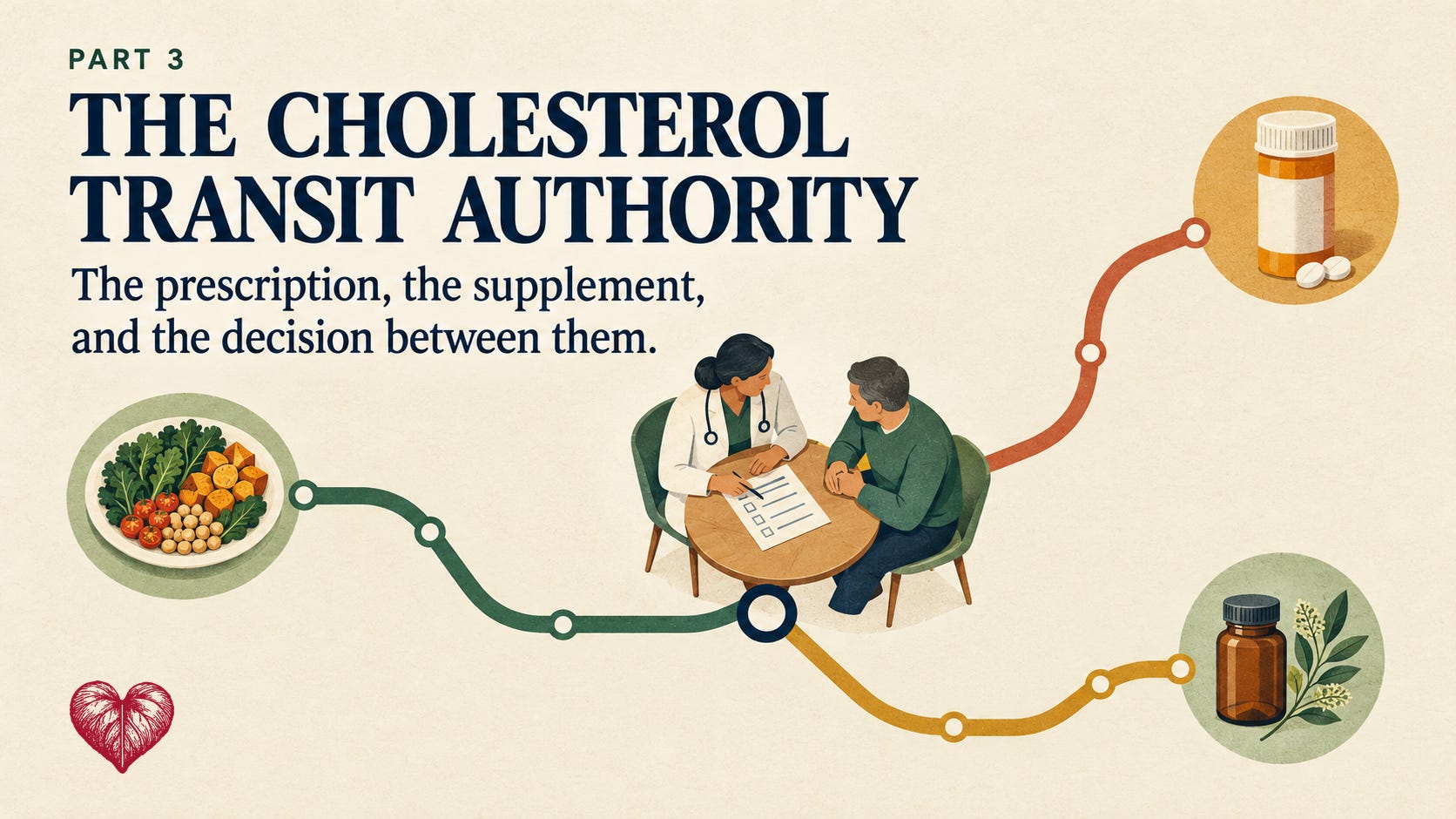
Medications and Supplements: What Actually Lowers Risk
“Can I try something natural first?”
That question opens a conversation, not an argument. Before discussing a prescription or a supplement, I want to understand what the patient hopes to accomplish, what worries them, and how quickly we need to act.
My job is to explain what I recommend, how it might help, its limits, and the risks of waiting. The patient makes the decision with that information. Respecting their choice does not mean pretending every option is equally safe.
Some patients worry about side effects. Others dislike the idea of taking medicine for years, have had a difficult experience with treatment, or prefer an approach they see as more natural. I want those concerns on the table. An honest conversation is different from handing over a prescription the patient never intends to take.
The Short Version
My first prescription is food: I use Dr. Andrew Weil’s anti-inflammatory eating plan, with practical guidance and changes the patient feels ready to make.
Timing matters. Preventing another heart attack or stroke is a different conversation from preventing a first one in someone at lower risk.
At follow-up, we ask what changed in daily life and what changed in the blood tests. Both matter.
A supplement cannot automatically replace a prescription. Better blood-test results and fewer heart attacks or strokes are different findings.
We make decisions together and revisit them as the patient’s health, results, and wishes change.
A Brief Return to the Transit Map
In Parts 1 and 2, we explored how cholesterol travels through the body and what food and movement can change. This final installment turns to prescriptions and supplements.
The question is not simply which product lowers a number. It is whether that option belongs in this person’s plan to protect their health.
What Medications Can Do
Statins: Slow the liver’s cholesterol production. The liver responds by adding more LDL receptors, proteins that help remove LDL particles from the blood. LDL is the cholesterol carrier often called “bad cholesterol.” Studies show that statins reduce heart attacks and strokes in patients who stand to benefit. The medicine and dose depend on the person’s risk. (2026 guideline; Endotext)
Ezetimibe: Reduces the cholesterol absorbed through the intestine. In IMPROVE-IT, adding it to a statin reduced a combined measure of serious heart and circulation problems in people recently hospitalized with a heart attack or unstable heart-related chest pain. That is not the same as showing fewer deaths, or promising the same benefit to everyone. (Cannon et al.)
Medicines targeting PCSK9: This protein helps control how quickly LDL receptors are broken down. Evolocumab and alirocumab block it; inclisiran reduces how much the liver makes. More receptors remain available to clear LDL. FOURIER examined serious heart and circulation problems with evolocumab; ORION-10 and ORION-11 measured LDL lowering with inclisiran. Those studies answered different questions. (Sabatine et al.; Ray et al.)
Bempedoic acid: Reduces cholesterol production at a different step from statins. CLEAR Outcomes studied people unable or unwilling to take statins because of side effects. It reduced a combined measure of serious heart and circulation problems, but did not show a reduction in deaths overall. It is an option to discuss, not the automatic next choice for everyone. (Nissen et al.)
Icosapent ethyl: A prescription form of purified EPA, an omega-3 fat, not ordinary fish oil. REDUCE-IT found fewer serious heart and circulation problems in selected patients already taking statins who had raised triglycerides, another type of blood fat. Its role differs from simply lowering LDL. (Bhatt et al.)
The conversation should cover likely benefit, side effects, how the medicine could affect other treatments, cost, and follow-up. Knowing how a drug works is only part of the decision.
I also want patients to distinguish “What can this medicine do?” from “Why are you recommending it for me?” The first question is about the treatment. The second is about their circumstances and the goal we are trying to reach.
An Honest Tour of the Supplement Aisle
When patients ask about supplements, I want to know what they expect. Is the goal to improve a blood-test result, ease a symptom, or replace a prescription I have recommended?
These studies asked different questions and enrolled different kinds of patients. Improving a blood-test result does not, by itself, prove that a product prevents heart attacks or strokes. The 2026 cholesterol guideline does not recommend dietary supplements for lowering LDL or triglycerides because evidence is limited or inconsistent. The discussion below explains the evidence, not a shopping list. (2026 guideline)
I want to review the actual product label alongside the patient’s medicine list. We should know what we hope to gain, what remains uncertain, and what would make us stop. Otherwise, we may be adding another bottle without a clear plan.
Options studied for blood-test results or symptoms
Soluble fiber: Psyllium and beta-glucan, a fiber in oats and barley, belong in the food discussion before more elaborate products. A review combining controlled studies of psyllium found lower LDL, non-HDL cholesterol, and ApoB. The latter two tests look beyond LDL alone at cholesterol or particles linked to artery disease. Those blood-test improvements do not establish fewer heart attacks or deaths. (Jovanovski et al.)
Fish-oil supplements: EPA and DHA are two omega-3 fats. In STRENGTH, a high-dose EPA/DHA mixture did not reduce serious heart and circulation problems. REDUCE-IT studied a different prescription product and group of patients. Its results should not be applied to ordinary fish-oil supplements. (Nicholls et al.; Bhatt et al.)
Garlic products: Studies have looked at effects on blood pressure and cholesterol. The products and studies differ; their findings do not show that a garlic supplement can replace treatment someone needs. (Ried)
Coenzyme Q10: The question here is muscle symptoms, not lowering LDL. A 2025 review suggested possible relief, but studies were small and their results differed substantially. The 2026 guideline does not recommend routine CoQ10 to prevent or treat statin-related muscle symptoms. New muscle symptoms deserve evaluation, not just another supplement. (Kovacic et al.; 2026 guideline)
Products that deserve particular caution
Red yeast rice shows why “natural” does not settle the decision. Some products contain monacolin K, the same chemical as the prescription statin lovastatin. That means statin-type side effects and interactions with other medicines are possible, while the amount in the bottle can vary. (NCCIH)
There have been legal disputes about how these products should be regulated, including the Cholestin case. For patients, the practical question is what they are taking. An analysis of 28 brands found widely differing amounts of monacolin K, without those amounts listed on the labels. (Pharmanex v. Shalala; Cohen et al.)
Other substances in red yeast rice are of scientific interest. But according to the National Center for Complementary and Integrative Health, we do not know whether products with little or no monacolin K work. (NCCIH)
If someone wants to avoid a statin because it is a drug, that distinction matters. Calling a product a supplement does not remove its drug-like effects or the need to discuss safety and follow-up. (NCCIH)
Berberine has evidence of effects on cholesterol and other blood fats, but it can also interact with medicines. An improvement in LDL is not a reason to take it without reviewing those risks. (Ju et al.; NCCIH safety guidance)
Modest add-ons, with limits
Plant sterols and stanols: These plant substances reduce cholesterol absorption and can lower LDL modestly. That does not establish the same protection against heart attacks and strokes demonstrated for some prescription treatments. (Gylling et al.)
Bergamot: A small, six-month study of a specific extract reported improved cholesterol levels. That is not enough to promise the same result from another product or establish protection against heart attacks. (Toth et al.)
Green tea: A review combining several studies found modest changes in cholesterol. Drinking tea and taking a concentrated extract are not the same thing; I would not recommend either in place of needed treatment. (Zheng et al.)
Products I would not use instead of established treatment
Niacin: Added to statin-based treatment, niacin did not provide added protection against serious heart and circulation problems in AIM-HIGH and HPS2-THRIVE despite better cholesterol numbers. HPS2-THRIVE tested niacin with laropiprant and found more serious adverse events. Buying it without a prescription is not a way around the treatment discussion. (Boden et al.; Landray et al.)
Curcumin: A 2025 review found modest average improvements in cholesterol and triglycerides, but results varied widely and confidence in the evidence was low. Those findings do not establish fewer heart attacks or strokes, or justify replacing established treatment. (Unhapipatpong et al.)
Guggul: A controlled US study did not support the cholesterol-lowering claims and found side effects. (Szapary et al.)
Policosanol: A well-designed independent study did not reproduce the large improvements in cholesterol reported in earlier studies. (Berthold et al.)
Nattokinase: The cholesterol evidence is not convincing enough for me to recommend it for that purpose. Possible interactions, especially with medicines that affect blood clotting, also need attention. (Li et al.; Memorial Sloan Kettering)
How I Make These Decisions With My Patients
That brings us from the list of options to the person sitting across from me. I do not rank a treatment by whether it comes from a pharmacy or a supplement aisle. I rank it by what it can accomplish, how strong the evidence is, and what harm it might cause.
For prescriptions, I ask: How well does it work? Does it improve a blood-test result, prevent serious problems such as heart attacks and strokes, or help people live longer? How much does it help, over how many years, and in people like my patient? I want to know how much their actual chance of a problem might fall, not just a percentage that sounds impressive. Then I weigh side effects, effects on other medicines, and the demands of treatment.
I ask the same questions about supplements. What does the research show they can do? How much might they help, and what could go wrong? Does the bottle contain the same ingredients and amounts as the product studied, and are those amounts consistent from bottle to bottle? Where we do not have answers, I say so rather than assume benefit or safety.
Those questions guide my recommendations, not a fixed best-to-worst list for everyone. Better blood-test results, fewer heart attacks, and longer life are different findings. We then consider the patient’s risk, how quickly we need to act, and what they feel ready to do.
And although I have discussed the bottles first here, my office conversation usually starts somewhere else: the food on the plate.
Food before the supplement aisle
Supplements usually enter the conversation because a patient asks for something “natural.” My first response is to discuss food, not another bottle.
I use Dr. Andrew Weil’s anti-inflammatory diet, not a diet I developed. My 17-page illustrated eating guide is exactly that: a guide I created to help patients follow his recommendations.
I emphasize meals built mostly around whole plant foods. Some animal foods can fit. But when someone wants to lower cholesterol through daily habits, I ask them to view food as medicine: something we plan carefully, not simply an intention to “eat better.”
One visit is often not enough to make all those changes. As an integrative cardiologist, I am trained in motivational interviewing: a way of talking with patients about their own reasons for change and what feels possible. I listen to how they describe their habits and concerns. We choose a path they are ready to take, rather than making the whole plan an assignment due by the next visit.
That takes time. We may start with one meal, a change in the grocery cart, or a habit the patient feels able to sustain. At the next visit, we build on what happened and work through what got in the way.
When I show patients Dr. Weil’s food pyramid, the chocolate and wine near the top often catch their attention first. But a pyramid stands on a foundation: the broad base where the vegetables and fruits are.
That is where we start. Not at the tip, but with the foods that form the foundation of everyday meals. And wine’s appearance in the pyramid is not a reason to start drinking; Dr. Weil explicitly advises nondrinkers not to start. (Dr. Weil’s pyramid guide)
Urgency shapes the options
Food is central to my approach, but timing matters. “Secondary prevention” means preventing further problems in someone who already has cardiovascular disease. “Primary prevention” means preventing a first problem. I do not have the same conversation with someone who has already had a heart attack as with someone whose overall risk is low.
When a patient declines medicine, I explain my concerns and keep talking. If their overall risk looks more reassuring, we may agree on time to work intensively on daily habits, with regular checkups. When the risk is very high, I explain my recommendation more firmly and meet with them more often.
The right to make their own decision does not disappear when we disagree. Neither does my responsibility to explain the risk.
Some patients want more information. Some want time to try a plan. Others understand my recommendation but do not intend to take medicine. Those conversations need different responses. Repeating a warning more loudly is not a substitute for understanding the person.
What happens at the next visit
At each visit, we return to the plan. What did we agree to change? What became part of everyday life? What was difficult, and what needs to be more workable?
Then we look at the results. Making the changes and getting the hoped-for blood-test results are two different things. A disappointing number should not automatically become a judgment about effort.
If the changes have not happened, I ask what got in the way before making the plan harder. If they have, we look at what they achieved. When someone feels they have made all the changes they can keep up, we include that in the next discussion about medicine and dose.
During this closely followed lifestyle plan, I may repeat blood tests, including CRP, an inflammation marker, every three to six months. We revisit medication each time. The schedule and decisions are tailored to the person, not rules for everyone.
Some patients want to see how far they can climb through their own efforts. I help them judge their progress and what else they can keep doing. Accepting help is not failure, and the need to act may be more important than finishing the climb alone.
The aim is not to avoid a prescription at any cost. It is to make a plan while being clear about what the patient wants, what I recommend, and what the research can tell us.
The Decision We Make Together
I do not want patients to leave with a longer shopping list. I want them to understand why I recommend a plan, what we still do not know, and what we will check next.
For someone changing daily habits, we discuss both the changes and the results. For someone starting medicine, we discuss how they feel taking it as well as what the tests show. For someone declining my recommendation, the conversation stays open.
Useful questions include:
What about my risk makes you recommend this option now?
How much might this help me?
What would make waiting riskier?
What side effects, effects on my other medicines, costs, or daily difficulties should we discuss?
What will we check again, and when?
That is the decision between the prescription and the supplement: not which feels more natural, but what each can offer in a plan the patient understands and helps shape.
This article is for patient education. It is not a substitute for individualized medical advice. Cholesterol and cardiovascular risk management should be directed by your physician using validated risk assessment and current guideline-based therapy. Do not start or stop any medication or supplement without discussing it with your clinician, particularly if you take other prescriptions.
Key Sources
Dietary framework
Andrew Weil, MD. Anti-Inflammatory Diet & Pyramid.
Andrew Weil, MD. Dr. Weil’s Anti-Inflammatory Diet and Food Pyramid.
Medications
Feingold KR. Cholesterol Lowering Drugs. Endotext. Updated April 23, 2026.
Supplements: Blood-test results or symptoms
Supplements: Pharmacologically real
National Center for Complementary and Integrative Health. Red Yeast Rice: What You Need to Know.
Pharmanex, Inc. v. Shalala, 221 F.3d 1151 (10th Cir. 2000).
NCCIH. Berberine and Weight Loss: What You Need To Know (interaction guidance).
Supplements: Modest add-ons
Supplements: Limited, mixed, or negative evidence
Memorial Sloan Kettering Cancer Center. Nattokinase (safety and interactions).