

The Integrative Cardiologist · By Sameer Azhak, MD, FACC
He was 42 and recently retired from police work. His primary-care doctor sent him to me to check his risk of heart disease.
His coronary calcium score was zero. This scan looks for calcium deposits in the arteries that feed the heart, and it found none. ¹ His heart ultrasound showed a normal heart that pumped well. He also did very well on a treadmill stress test.
But the calcium scan report mentioned something outside the heart: fat had built up in his liver.
An ultrasound of the arteries in his neck showed mild plaque on both sides.
His bloodwork and measurements filled in more of the picture:
His waist measured 42 inches.
His triglycerides, a type of fat carried in the blood, were high.
His HDL cholesterol, the kind that helps clear cholesterol away, was low. ²
His blood pressure was 146/87 in the office, and his home readings averaged about 132/78. Both are above the target of 130/80. ³
His blood sugar and A1c were in the prediabetes range.
His fasting insulin level raised more concern about how his body was handling fuel.
He also smoked about half a pack of cigarettes a day.
It would have been easy to treat each finding as its own small problem: a little extra blood sugar, a few off cholesterol numbers, some liver fat, mild plaque in the neck.
The more useful question was how they fit together.
The thread that tied them together was insulin resistance. This is a condition in which the body stops responding well to insulin, and it can affect far more than blood sugar. ⁴
The hormone working overtime
Insulin is a hormone made by the pancreas, a gland that sits behind the stomach. One of its main jobs is to help move glucose, the sugar in your blood, into cells that can burn it or store it. ⁵ ⁴
Insulin also tells the liver when to stop releasing sugar. And it tells fat tissue when to hold on to stored fat. ⁶
When the body stops responding well to insulin, the pancreas makes up for it by producing more. ⁷
Think of a message that is getting harder to hear. The pancreas turns up the volume.
For a while, that extra insulin can keep blood sugar from rising very much. ⁷
That is why blood sugar alone does not tell the whole story. A number that looks only a little high may be held there by a system that is working much harder than it should.
His fasting blood sugar was 103 mg/dL. His A1c, which reflects average blood sugar over the past two to three months, was 5.8%. ⁴
Both were in the prediabetes range, meaning higher than normal but not high enough to be called diabetes. ⁴
But I did not look at those numbers alone. His waist size, liver fat, cholesterol pattern, and insulin level all belonged in the same assessment.
The concern was not just where his blood sugar was that day.
It was how hard his body was working to keep it there.
Why this is more than a blood sugar problem
After a meal, your body has to decide what to do with the incoming fuel.
Muscles can burn sugar for energy or store some for later. The liver helps manage the supply of both sugar and fat. Fat tissue stores energy and releases it when you need it. ⁶
Insulin helps coordinate all of these jobs.
When the body stops responding well to insulin, that teamwork breaks down.
Muscles may not take in sugar as well. The liver may keep releasing sugar when it should slow down. Fat tissue may release more fat into the blood. ⁶
The pancreas responds by making more insulin. But the problem is not limited to sugar.
It can also show up as fat in the liver, higher triglycerides, lower HDL, and other changes that affect the arteries. ⁷ ⁸
These can be parts of one connected system, rather than unrelated findings.
The liver finding mattered
His calcium scan was ordered to look for calcium in the arteries of his heart.
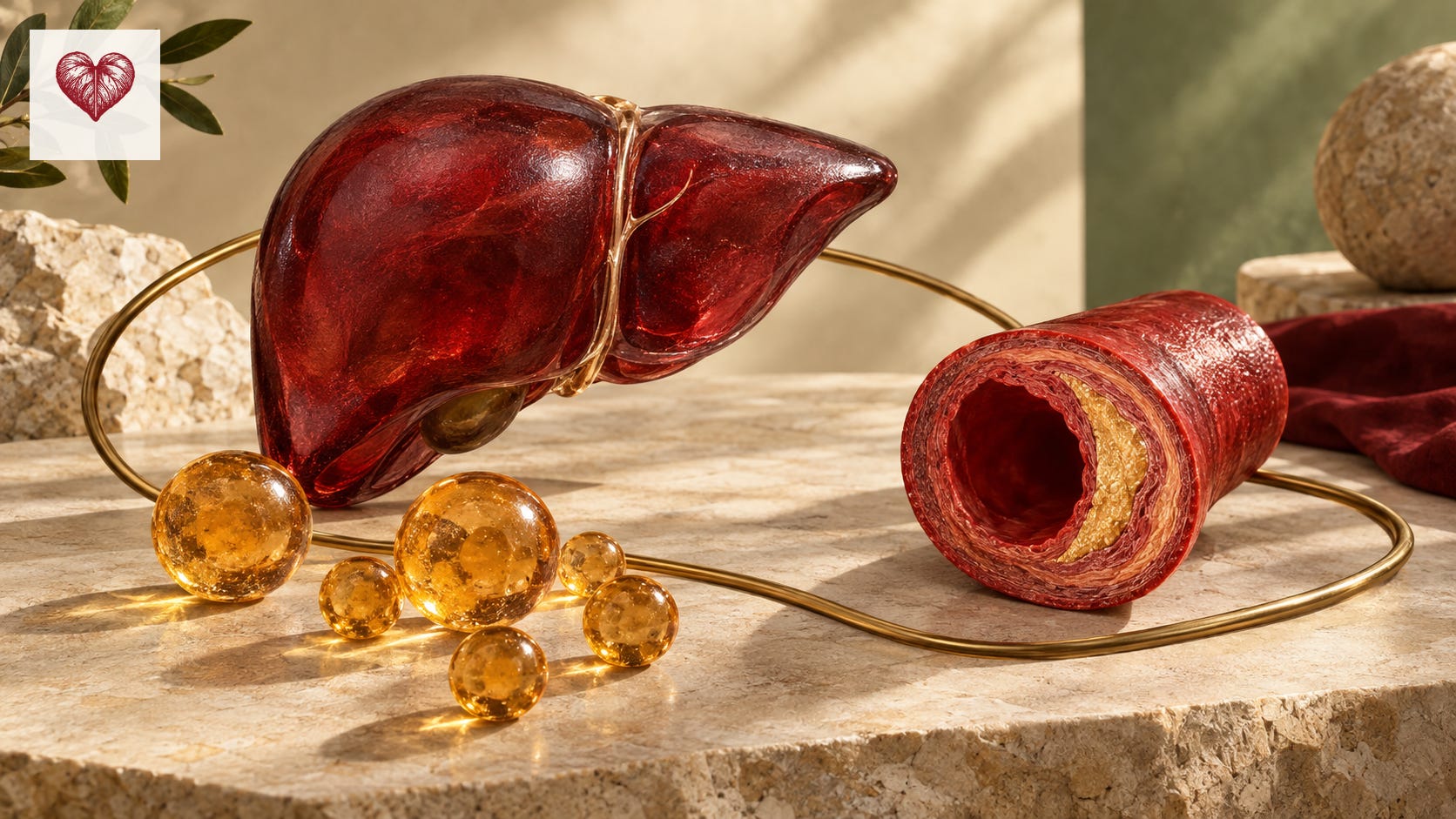
But the report also noted hepatic steatosis. That is the medical term for fat buildup in the liver. ⁸
In everyday language, he had a fatty liver.
The liver is the body’s fuel-processing plant. It takes in fat, makes some fat of its own, and packages fat to send to other parts of the body.
When the body resists insulin, more fat can reach the liver, and the liver may handle it differently.
Some of that fat may stay in the liver. Some may be sent back into the blood inside fat-carrying particles. ⁶ ⁷
This helps explain why fatty liver, high triglycerides, and low HDL so often show up together. ⁷ ⁸
In his case, the liver fat was not just a guess based on a blood test. It was visible on the scan.
The scan could not tell us whether his liver was inflamed or scarred. Those are separate questions that need their own testing. ⁸
But it did show that his problem went beyond a slightly high blood sugar.
How this connects to plaque
Plaque is a buildup inside the wall of an artery. It can contain cholesterol, cells involved in inflammation, and other material. ⁹
Over time, plaque can lead to heart attacks, strokes, and other problems with blood flow. ¹⁰
Insulin resistance does not build plaque by itself. But it can create conditions that make plaque more likely to form. ⁷
Those conditions can include:
More of the harmful fat-carrying particles in the blood.
Higher blood pressure.
Changes in the thin inner lining of the blood vessels, which normally helps keep them healthy.
Changes in the body’s inflammation response. ⁷
Smoking adds another source of damage. ⁹
Here is an important point. We cannot look at one patient and prove that insulin resistance caused his plaque.
But we can recognize a pattern that can contribute to artery disease, and we can act on the parts we can change.
He already had mild plaque in his neck arteries. This was not only about what might happen years from now.
There was existing disease to take seriously.
What his cholesterol results added
His LDL cholesterol was 145 mg/dL.
LDL is often called “bad cholesterol,” but that label leaves something out. Cholesterol does not float freely in the blood. It rides inside tiny particles, a bit like passengers in cars.
The LDL number tells you how much cholesterol is on board. It does not tell you how many cars are on the road. The two are related, but they are not the same. ¹¹
A more detailed blood test, called an NMR lipid profile, counted his LDL particles directly. His count was 1,942 nmol/L. The lab considers anything from 1,600 to 2,000 high. ¹¹ That added to my concern, because LDL particles are what carry cholesterol into the artery wall. ¹²
His triglycerides were 164 mg/dL, and his HDL cholesterol was 32 mg/dL.
Together, these results showed how his body was moving fat through the blood.
Low HDL was not just a number to push up on its own. High triglycerides were tied to the fat in his liver. And the LDL results mattered even more because he already had plaque. ⁷ ¹²
The goal was to change the overall conditions that let artery disease grow, not just to fix one number on a lab report.
His calcium score was zero. His neck arteries had plaque.
Both findings were true.
They answered different questions.
The calcium scan looked for calcium in the arteries that feed the heart, called the coronary arteries. ¹
The neck ultrasound looked at a different set of arteries: the carotid arteries, which carry blood to the brain. ¹³
A zero calcium score did not make the plaque in his neck disappear. And the plaque in his neck did not prove he had plaque in his heart arteries.
His heart ultrasound answered another question: how his heart was built and how well it pumped. ¹⁴
His treadmill test showed how he handled exercise. ²
Each test told us something. None replaced the others.
He could exercise well, have a heart that pumped normally, show no calcium in his heart arteries, and still have plaque in his neck.
Smoking was part of the same conversation
He smoked about half a pack of cigarettes a day.
We talked about quitting, but he was not ready.
So we agreed to start with something he was willing to do: cut down, while keeping quitting as the goal.
This is a reasonable path. In a large review of research, people who cut down first and then quit were about as successful as people who stopped all at once. ¹⁵
I gave him a simple assignment.
Put the cigarettes in a clear zip-top bag.
I have used this approach in my practice for years. The idea is to make the habit visible.
A pack hides the cigarettes. A clear bag lets you see your supply and watch it shrink.
My goal was to create a pause before each cigarette, so that smoking became a choice instead of an automatic reach.
At his follow-up visit, he had cut down to five cigarettes a day, about half of what he smoked before.
That was a real change in behavior.
It does not prove the bag alone made the difference. Our talks, his motivation, and his own decision to cut back could all have played a part.
And five cigarettes a day was not the finish line. For the heart, there is no safe level of smoking. A large analysis of 141 studies found that men who smoked about one cigarette a day still carried roughly half of the extra heart disease risk seen in men who smoked a full pack. ¹⁶ Cutting down is a step toward quitting. It is not a substitute for it.
Quitting is the goal, and help works. Expert guidelines recommend that people who smoke be offered both counseling and FDA-approved quit-smoking medicines, such as nicotine patches, gum, or lozenges; bupropion; or varenicline. ¹⁷ Using both together tends to work better than using either one alone. ¹⁷
If you smoke and want support, talk with your doctor. You can also call 1-800-QUIT-NOW for free, private coaching from a trained quit coach. ¹⁸
What we decided to do
I recommended a statin, a medicine that lowers cholesterol. I based this on his plaque, his cholesterol results, his smoking, and his other risk factors. ¹²
He wanted a chance to work on his diet before starting medicine.
That was his choice. It did not mean that waiting was free of risk.
Food changes and medicine do not have to compete. Improving how your body handles fuel does not remove the need to lower the cholesterol-carrying particles that build plaque. ¹²
We also talked about an eating pattern built mostly around plant foods:
Vegetables and whole fruit.
Beans and lentils.
Whole grains.
Nuts and seeds.
Sensible portions.
Fewer sugary drinks, refined foods, and heavily processed snacks. ⁸ ¹²
The aim was bigger than lowering his blood sugar.
We wanted to address the whole pattern: his waist, liver fat, blood pressure, and blood fats.
Cutting down on smoking, with continued support to quit, belonged right alongside that work.
This is not a reason to fear every carbohydrate
When people hear “insulin resistance,” they are often told to avoid carbohydrates.
But lentils and soda are not the same food. Neither are an apple and a pastry.
Beans, vegetables, whole fruit, and whole grains bring fiber and other nutrients. How much you eat, how the food is prepared, and your overall eating pattern all matter. ⁸ ¹²
I did not want him to leave thinking that every food with carbohydrates was a threat.
I wanted him to build meals around foods that could support lasting change.
Movement, strength training, sleep, and quitting smoking also belonged in the plan. ⁸ ⁴ ¹⁷
No single food, supplement, or blood test could stand in for the whole picture.
What we know so far
We know he had mild plaque in both carotid arteries.
We know his scan showed fat in his liver.
We know his waist size, blood pressure, blood sugar, and cholesterol results formed a worrying pattern.
And we know he cut his smoking from about half a pack a day to five cigarettes a day.
We do not yet have repeat bloodwork or follow-up testing of his liver to report.
We cannot say that his plaque shrank, that his liver fat went down, or that his blood sugar and cholesterol improved.
Those answers need follow-up, not guesses.
But we did not need to wait for those results, or for diabetes, to know it was time to act.
The bigger lesson
His fasting blood sugar was 103.
On its own, that number might have gotten a quick mention and little more.
But he was not a blood sugar number.
He was a 42-year-old man with fat in his liver, a large waist, abnormal blood fats, high blood pressure, a smoking habit, and plaque in the arteries of his neck.
His calcium score was zero. His exercise performance was excellent.
All of those findings belonged in the same conversation.
Insulin resistance matters because its effects reach beyond blood sugar. It can help set the stage for artery disease long before diabetes is diagnosed. ⁷
The opportunity is to spot that pattern early and work on what drives it.
Not to wait for a higher blood sugar number to make the problem official.
This article is for general education and is not a substitute for individualized medical care. Do not start, stop, or change treatment based on this article. Decisions about testing and treatment should be made with your own doctor.
References
Radiological Society of North America; American College of Radiology. Cardiac CT for Calcium Scoring. RadiologyInfo.org. Reviewed July 15, 2026. Accessed November 3, 2026. Reference page.
Radiological Society of North America; American College of Radiology. Cardiac (Heart) Screening. RadiologyInfo.org. Reviewed August 25, 2024. Accessed November 3, 2026. Reference page.
American Heart Association; American College of Cardiology. 2025 Guideline for the Prevention, Detection, Evaluation, and Management of High Blood Pressure in Adults: Clinical Slide Set. 2025. Accessed November 3, 2026. Reference page.
National Institute of Diabetes and Digestive and Kidney Diseases. Insulin Resistance & Prediabetes. Reviewed March 2025. Accessed November 3, 2026. Reference page.
National Institute of Diabetes and Digestive and Kidney Diseases. Pancreas. Diabetes Dictionary. Accessed November 3, 2026. Reference page.
Petersen MC, Shulman GI. Mechanisms of Insulin Action and Insulin Resistance. Physiol Rev. 2018;98(4):2133–2223. doi:10.1152/physrev.00063.2017. Full text or guideline.
Ormazabal V, Nair S, Elfeky O, et al. Association between insulin resistance and the development of cardiovascular disease. Cardiovasc Diabetol. 2018;17:122. doi:10.1186/s12933-018-0762-4. Full text or guideline.
European Association for the Study of the Liver; European Association for the Study of Diabetes; European Association for the Study of Obesity. EASL-EASD-EASO Clinical Practice Guidelines on the Management of Metabolic Dysfunction-Associated Steatotic Liver Disease (MASLD). Obes Facts. 2024;17(4):374–444. doi:10.1159/000539371. Full text or guideline.
National Heart, Lung, and Blood Institute. Atherosclerosis: Causes and Risk Factors. Updated October 28, 2024. Accessed November 3, 2026. Reference page.
National Heart, Lung, and Blood Institute. What Is Atherosclerosis? Updated October 28, 2024. Accessed November 3, 2026. Reference page.
Labcorp. LDL-P: Low-density Lipoprotein Particle Number. Test 123828. Accessed November 3, 2026. Reference page.
Blumenthal RS, Morris PB, Gaudino M, et al. 2026 ACC/AHA/AACVPR/ABC/ACPM/ADA/AGS/APhA/ASPC/NLA/PCNA Guideline on the Management of Dyslipidemia: A Report of the American College of Cardiology/American Heart Association Joint Committee on Clinical Practice Guidelines. Circulation. 2026;153(17):e1154–e1276. doi:10.1161/CIR.0000000000001423. Full text or guideline.
Radiological Society of North America; American College of Radiology. Ultrasound: Carotid. RadiologyInfo.org. Reviewed June 15, 2026. Accessed November 3, 2026. Reference page.
American Heart Association. Echocardiogram (Echo). Reviewed February 24, 2025. Accessed November 3, 2026. Reference page.
Lindson N, Klemperer E, Hong B, Ordóñez-Mena JM, Aveyard P. Smoking reduction interventions for smoking cessation. Cochrane Database Syst Rev. 2019;9:CD013183. doi:10.1002/14651858.CD013183.pub2. Article record.
Hackshaw A, Morris JK, Boniface S, Tang JL, Milenković D. Low cigarette consumption and risk of coronary heart disease and stroke: meta-analysis of 141 cohort studies in 55 study reports. BMJ. 2018;360:j5855. doi:10.1136/bmj.j5855. Full text or guideline.
US Preventive Services Task Force. Interventions for Tobacco Smoking Cessation in Adults, Including Pregnant Persons: US Preventive Services Task Force Recommendation Statement. JAMA. 2021;325(3):265–279. doi:10.1001/jama.2020.25019. Full text or guideline.
Centers for Disease Control and Prevention. Quitlines and Other Cessation Support Resources. January 31, 2025. Accessed November 3, 2026. Reference page.