

The Integrative Cardiologist · By Sameer Azhak, MD, FACC
At a Glance
Your artery lining makes nitric oxide, a gas that helps the surrounding muscle relax. Your body produces it through an enzyme pathway and through a second pathway that uses nitrate from foods such as leafy greens and beets.¹,²
Beetroot juice has lowered blood pressure in some trials. Results vary, and one favorable trial does not tell us how much benefit you should expect.³,⁴,⁵
Garlic & Garlic supplements can lower blood pressure in people with hypertension, but the evidence comes from specific preparations—not simply adding a clove to dinner.⁶,⁷,⁸
Excess added sugar, particularly in sweetened drinks, deserves attention. Ordinary portions of whole fruit are not the target.⁹,¹⁰,¹¹
Exercise helps your arteries make nitric oxide and supports vascular function. Its benefits extend well beyond this one pathway.¹²,¹³
These approaches belong in a broader plan. Their study results cannot be added together to predict your response, and none is a reason to stop prescribed treatment on your own.¹⁴
“Is there anything I can eat or do besides another pill?”
I hear this question often when we discuss high blood pressure.
You deserve a better answer than “eat healthy.”
We’ve already talked about magnesium, sleep, exercise, and other parts of a blood-pressure plan. This article builds on that foundation, taking a closer look at nitric oxide and how everyday choices can support the work your blood vessels are already doing.
Part of the answer begins inside your blood vessels. Their lining makes nitric oxide, a gas that tells the surrounding muscle to relax. Several foods and habits influence how much is available and how well that signal works.¹
Think of your artery lining as a pharmacy that produces some of its own medicine.
The comparison is not exact. Blood pressure depends on your kidneys, hormones, nervous system, arteries, medications, and more. But it captures something useful: your vessels do not simply carry blood. They actively help control the pressure.¹³,¹⁵
This article is about supporting that work—not replacing treatment you need.
Two roads to the same gas
The endothelium is the thin layer of cells lining your arteries.¹²
Those cells contain an enzyme called endothelial nitric oxide synthase, or eNOS. It converts the amino acid arginine into nitric oxide. The gas moves into nearby muscle cells and activates signals that help the artery relax.¹²
One important trigger is blood flow itself.
As blood moves along the lining, it creates a mechanical force called shear stress. That signal can activate eNOS. Repeated stimulation through exercise also helps the vessels adapt over time.¹,¹²,¹³
Your body has two routes:
The enzyme road: An enzyme called eNOS uses arginine to produce nitric oxide. Exercise supports this pathway. Cocoa flavanols and other dietary components may influence it too.¹,¹²,¹⁶
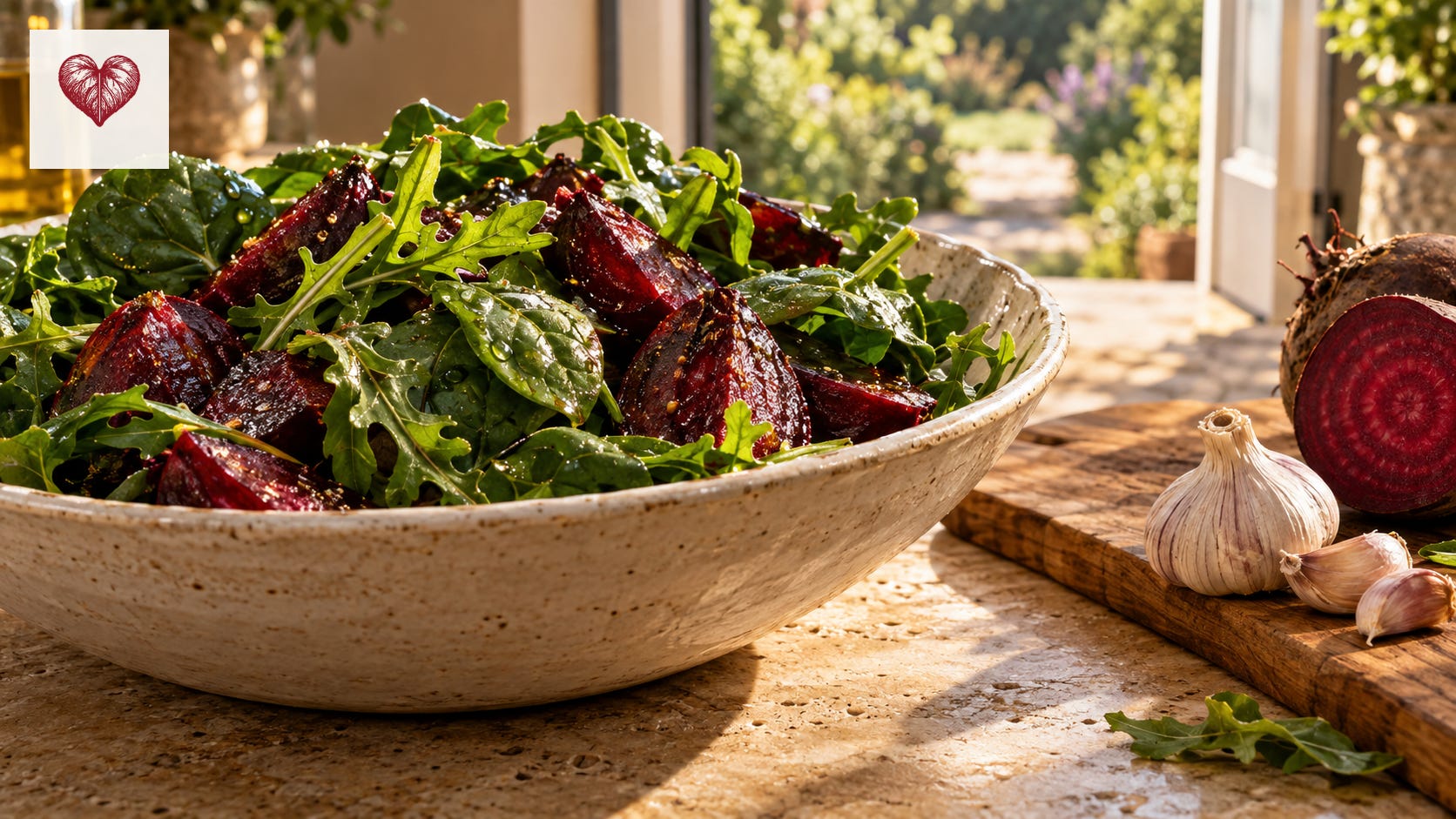
The nitrate road: Dietary nitrate becomes nitrite, which can then become nitric oxide. Leafy greens and beets supply nitrate. Bacteria in your mouth help with the conversion.²,¹⁷
Both routes contribute to nitric-oxide availability, but they are not interchangeable—and neither works in isolation from the rest of your health.¹²,¹⁷
Why the supply can falter
Nitric oxide is short-lived. Oxidative stress can reduce its availability before it delivers its signal.¹²,¹⁵
Pressure-raising pathways, including angiotensin II signaling, can increase production of reactive molecules in the vessel wall. These can interfere with nitric oxide and vascular relaxation.¹³,¹⁵
The enzyme itself can also malfunction.
eNOS needs supporting molecules to work properly. When those supports are disrupted, it can become “uncoupled,” producing more superoxide instead of nitric oxide.¹²
The pharmacy starts producing the wrong product.
This is one part of the relationship between hypertension and vascular dysfunction. High pressure can damage the lining, while impaired vessel relaxation can help sustain high pressure.¹³,¹⁵
The goal is not to flood your body with a gas. It is to support the pathways that make it and reduce the conditions that interfere with its action.
Beets and leafy greens: the nitrate road
The nitrate pathway starts with conversion—not with nitrate acting like a conventional drug.
After you eat nitrate-rich vegetables, nitrate enters your bloodstream. Some returns to your saliva. Bacteria on your tongue convert it into nitrite, which you swallow. Your body can then convert that nitrite into nitric oxide.²,¹⁷
In a 2008 experiment, beetroot juice lowered blood pressure within hours. When participants interrupted the saliva pathway by spitting rather than swallowing, the blood-pressure effect disappeared.²
The mouth was not optional.
What the blood-pressure trials found
One influential trial enrolled 68 adults with hypertension. Participants drank 250 mL of nitrate-rich beetroot juice or nitrate-depleted placebo juice daily for four weeks.³
The nitrate group had a reduction of about 7.7/5.2 mm Hg in 24-hour ambulatory pressure, alongside improved measures of vascular function. The effect faded after the intervention stopped.³
That is an encouraging result—not the result everyone should expect.
A separate one-week trial in people already receiving hypertension treatment found that beetroot juice increased nitrate and nitrite levels without lowering blood pressure.⁴
An earlier pooled analysis found an average systolic reduction of about 4 mm Hg. Later analyses have also highlighted differences between clinic and 24-hour measurements; improvement in one does not guarantee a significant change in the other.⁵,¹⁸
The practical conclusion: nitrate-rich beet products help some people, but the response varies.
Start with vegetables
You do not need a shot or powder to eat nitrate-rich foods.
Arugula, spinach, lettuce, and beets are useful sources. Their nitrate content varies with the vegetable and growing conditions.¹⁷,¹⁹
In a Danish study following more than 53,000 adults for about 21 years, higher vegetable-nitrate intake was associated with lower blood pressure and less cardiovascular disease. The association with lower cardiovascular risk appeared to level off at a moderate intake.²⁰
That was an observational study, not proof that nitrate alone caused the benefit. People eating more vegetables may differ in other ways.
Still, the direction is practical: put vegetables on the plate before building a supplement routine.
The source matters
Evidence about nitrate-rich vegetables does not justify eating more processed meat.
In a large French cohort, nitrite from food additives was associated with a higher risk of developing hypertension. That does not prove that the additive caused the outcome, and processed meat differs from vegetables in much more than nitrate or nitrite content.²¹
Treat the whole food as the intervention—not one chemical on its label.
What about mouthwash?
Because mouth bacteria help convert nitrate, researchers have asked whether antiseptic mouthwash disrupts the pathway.²²
In one small study, chlorhexidine mouthwash sharply reduced oral nitrite production and raised blood pressure by a few points.²²
Pooled studies have been less consistent. Reviews have not established a large, dependable blood-pressure increase from mouthwash use.²³,²⁴
Do not throw out a rinse your dentist prescribed.
If you use a strong antiseptic rinse every day out of habit, ask whether you need it. Oral health matters too.²³,²⁴
Concentrated products deserve a separate decision
A daily beet shot is not the same decision as eating a serving of spinach.
Research doses of concentrated nitrate can exceed the conservative acceptable daily intake used by food-safety authorities. That does not mean those doses have been shown to cause harm. It does mean short trials cannot establish the benefit and safety of taking a concentrated product indefinitely.⁵,¹⁷,¹⁹,²⁵
Vegetables remain the foundation.
If you consider juice, shots, or powders:
Check the serving size and sugar content. Unsweetened does not necessarily mean sugar-free.¹¹
Recognize that nitrate content varies among products.²⁶
Review it with your clinician if you already take blood-pressure medicine or have a condition that affects your dietary choices.
Use home readings to assess the response rather than assuming the product is working.
Beets can temporarily turn urine or stools pink or red. If discoloration is unexplained, persists, or comes with symptoms, do not automatically assume it is from beets.²,³
Garlic: food and extract are different interventions
Garlic has a long history in food and medicine. Its chemistry changes when you crush it, heat it, or age it.²⁷,²⁸
Those distinctions matter because the blood-pressure trials tested particular preparations—not an interchangeable substance called “garlic.”
What crushing does
An intact clove keeps alliin separate from the enzyme alliinase.²⁷
Crush or chew the clove, and the two meet. Allicin forms, then breaks down into other sulfur compounds.²⁷,²⁸
In laboratory experiments, some garlic-derived compounds release hydrogen sulfide, another gas involved in vascular relaxation.²⁹
Allicin may contribute through the compounds it generates rather than circulating unchanged. The mechanism is more complicated than “allicin enters the blood and lowers pressure.”²⁸,²⁹
Heat changes the chemistry too. Cooking can inactivate alliinase, and the order of crushing and heating affects the compounds produced.²⁸,³⁰
For cooking, the simple approach is to crush first and avoid prolonged heating when you want to preserve more of that chemistry.³⁰
That is a food-preparation choice, not a proven blood-pressure dose.
What aging does
Aged garlic extract develops a different mixture of compounds, including the more stable S-allylcysteine.²⁷,²⁸
Laboratory work suggests that some aged preparations can support nitric-oxide-dependent relaxation. But those experiments do not establish exactly how an oral product lowers pressure in a person.³¹
What human trials show
A 2025 meta-analysis reported pooled reductions of roughly 8/4 mm Hg in people with hypertension, although products and trials differed.⁸
Some individual trials found larger effects:
One dose-ranging trial reported an approximately 11.8 mm Hg systolic reduction with a particular aged garlic extract regimen.⁶
A trial of time-released garlic powder tablets reported reductions of about 7.0/3.8 mm Hg in men with mild-to-moderate hypertension.⁷
Another aged-extract trial found a much smaller blood-pressure change despite changes in a nitric-oxide measure.³²
These results are not interchangeable. Product composition, baseline pressure, study size, and trial methods matter.
The studies cited here do not establish that hydrogen sulfide explains garlic’s blood-pressure effects in people. Nor do they establish that a favorable change in a nitric-oxide marker necessarily produces a meaningful clinical benefit.²⁹,³¹,³²
Garlic preparations may lower blood pressure. They have not been shown to prevent heart attacks or strokes in people with hypertension.³³
Garlic safety
Garlic in ordinary meals and concentrated garlic supplements are different exposures.
Supplements can increase bleeding risk. Tell your surgeon and prescribing clinician well before a procedure, and follow their instructions about stopping them.³⁴
A small trial of aged garlic extract in people taking warfarin did not identify an increased bleeding risk. That result applies to the studied product and population; it is not permission to combine any garlic supplement with a blood thinner.³⁵
Garlic supplements have also substantially reduced levels of saquinavir, an HIV medicine.³⁶
If you take anticoagulants, antiplatelet drugs, or HIV treatment, review a proposed supplement with your clinician or pharmacist first. Large amounts of raw garlic can also upset your stomach.²⁷,³⁴
Added sugar: the subtraction side
Supporting vascular health is not only about adding foods. Sometimes the useful change is removing an excess.
A large fructose load can rapidly consume energy molecules in the liver and increase uric-acid production. Experimental research suggests several ways this may interfere with nitric-oxide signaling.⁹
The human studies need context.
In one trial, men consumed 200 g of fructose daily for two weeks—far more than most people ordinarily consume. Their 24-hour blood pressure rose by about 7/5 mm Hg. Allopurinol, a uric-acid-lowering medicine, blunted much of the rise.³⁷
That does not mean you should take allopurinol to offset sugary drinks.
In U.S. survey data, higher added-fructose intake was associated with greater odds of elevated blood pressure. But feeding trials in which fructose replaced other carbohydrates calorie for calorie did not show the same increase.¹⁰,³⁸
Calories, dose, and food source matter.
The practical target is excess added sugar, especially sweetened drinks—not ordinary portions of whole fruit.¹¹
An apple is not the problem.
Agave, sweetened teas, large juice servings, and other products with a health-oriented label can still add substantial sugar. Look at what you drink over a week, not just what you sprinkle on food.¹¹
Cocoa and watermelon: promising, not magic
Cocoa flavanols
Flavanols are plant compounds that can support vascular function.¹⁶,³⁹
A 2025 analysis of 145 randomized trials found that flavan-3-ol interventions lowered office pressure by about 2.8/2.0 mm Hg and improved flow-mediated dilation, a measure of how well an artery widens. Effects were larger in participants starting with higher pressure.³⁹
That analysis included different flavanol sources; it was not simply a study of chocolate.
A Cochrane review focused on cocoa found a smaller average reduction of about 2 mm Hg.¹⁶
A candy bar is not the high-flavanol intervention tested in these studies. Product composition, sugar, and portion size still matter.
Watermelon and citrulline
Citrulline can be converted into arginine, the raw material used by eNOS.¹²,⁴⁰
A pooled analysis of 15 small trials involving middle-aged and older adults found reductions of about 4/2.5 mm Hg across citrulline and watermelon interventions, including some regimens combining citrulline with arginine.⁴¹
That is a reason for further study—not proof that an ordinary serving of watermelon delivers the same effect as a supplement. Its worth noting that citrulline is more concentrated in the white pulp compared to the sweeter center. Citrullus lanatus, the yellow watermelon is regarded at the highest dietary source of L-Citrulline.
Enjoy the food. Discuss the concentrated product separately.
Exercise: train the lining, not just the muscles
Each brisk walk increases blood flow along your artery lining.
That mechanical signal helps activate eNOS. Repeated training supports longer-term vascular adaptation. Exercise also influences oxidative stress and other processes that affect nitric-oxide availability.¹,¹²,¹³
You are training the vessels as well as the muscles.
A review of exercise interventions in people with hypertension found improvements in nitric-oxide measures and flow-mediated dilation.⁴²
More importantly for everyday care, exercise lowers resting blood pressure.
A 2023 analysis of 270 randomized trials found average systolic reductions of about 4.5 mm Hg with aerobic exercise. Resistance and interval training also helped. Isometric exercise—holding a contraction without moving—showed larger average reductions in that analysis.⁴³
A ranking across studies does not make one exercise best for every person.⁴³
The exercise you can perform safely and repeat consistently matters more than chasing the largest number in a table.
Build an aerobic foundation
Brisk walking, cycling, swimming, and similar activities are useful starting points.
A moderate pace generally lets you talk but makes singing difficult. Start where your health and fitness allow, then build a repeatable routine. If you have symptoms, known cardiovascular disease, or poorly controlled pressure, agree on a starting plan with your clinician.⁴⁴
Add strength and consider isometrics
Resistance exercise supports strength and function. Isometric options include handgrip training and supported wall holds.⁴³,⁴⁴
Trials have found benefits from repeated handgrip training—not simply one squeezing session.⁴⁵
A small comparison trial found that both wall-squat and handgrip training lowered clinic systolic pressure, without a statistically significant difference between the two.⁴⁶
The effort level matters. A study protocol is not automatically your starting prescription.
If you have uncontrolled blood pressure, cardiovascular disease, dizziness, or joint limitations, ask your clinician or an exercise professional how to begin. During holds, breathe continuously. Do not strain while holding your breath.⁴⁴
You do not need to master every exercise category this week. You need a safe place to start.
Putting both roads into daily life
A practical pattern might look like this:
Add leafy greens or beets to meals regularly.
Use garlic in cooking because you enjoy it—not because dinner must deliver a supplement dose.
Replace sweetened drinks with water, unsweetened tea, or sparkling water.
Choose cocoa products thoughtfully rather than treating candy as therapy.
Walk or do another aerobic activity regularly.
Add appropriate strength work and, when suitable, guided isometric training.
You cannot add the beet, garlic, cocoa, and exercise trial averages together to predict your result.
The effects overlap. Studies differ. Your starting pressure and current treatment matter.
How to tell whether the plan is helping
Use a validated upper-arm monitor and a consistent measurement routine. Compare averages over several days rather than celebrating or fearing one reading.¹⁴
Record medication timing and major changes in your routine. A home log shows whether your pressure is improving, although it cannot prove which part of a combined plan caused the change.¹⁴
For a step-by-step approach, see Four Blood Pressure Stories in The Integrative Cardiologist and the plan in Lower Your Blood Pressure.
What this does not replace
If you need medication now, take it.
Food and exercise may create an opportunity to simplify treatment later. That decision follows measurements and a clinical review—not the purchase of a supplement.¹⁴
I explain that conversation in “Do I Have to Take Blood Pressure Medication for the Rest of My Life?”
Concentrated products at a glance
Aged garlic extract: Some preparations lower blood pressure in people with hypertension. Responses vary among products and trials. Before starting, consider bleeding risk, planned procedures, medication interactions, and whether the product matches a studied preparation.⁶,⁸,³²,³⁴,³⁶
Beet juice, shots, or powders: Some trials show benefit. Average effects are generally modest and differ depending on how blood pressure is measured. Check nitrate content, serving size, and sugar. Consider your existing treatment and the limited evidence on long-term concentrated use.³,⁴,⁵,¹⁸,¹⁹,²⁵,²⁶
L-citrulline: Small trials suggest a possible blood-pressure benefit in middle-aged and older adults. Long-term evidence is limited. Review your other medicines and whether the expected benefit justifies adding another product.⁴⁰,⁴¹
A supplement label that says “nitric oxide support” does not establish that the product lowers blood pressure or prevents cardiovascular events.³³,⁴⁰
Protecting what you already make
So, is there anything you can eat or do besides another pill?
Yes.
Eat more vegetables. Use garlic as food. Replace sugary drinks. Move regularly.
Some concentrated products may help selected patients, but they are not interchangeable with the foods—or the medicines—studied in trials.
You do not need to chase a nitric-oxide number. You need a plan you can sustain and blood-pressure measurements that show whether it is helping.
Keep taking treatment you need.
If your readings improve, bring the log. That is how we decide together whether the plan can become simpler.
This post is for general educational purposes only. It is not medical advice, is not a substitute for care from your own physician, and does not create a physician-patient relationship. Do not start, stop, or change any treatment based on what you read here. If you think you may have a medical emergency, call 911 or go to the nearest emergency department.
Also by Dr. Azhak: Lower Your Blood Pressure: Help Your Doctor Reduce Your Medication, by Sameer Azhak, MD, FACC.
© 2026 Cordate Press
References
Hong J, Park Y. Microvascular function and exercise training: functional implication of nitric oxide signaling and ion channels. Pulse (Basel). 2024;12(1):27–33. doi:10.1159/000538271. Full text.
Webb AJ, et al. Acute blood pressure lowering, vasoprotective, and antiplatelet properties of dietary nitrate via bioconversion to nitrite. Hypertension. 2008;51(3):784–790. doi:10.1161/HYPERTENSIONAHA.107.103523. Article.
Kapil V, et al. Dietary nitrate provides sustained blood pressure lowering in hypertensive patients: a randomized, phase 2, double-blind, placebo-controlled study. Hypertension. 2015;65(2):320–327. doi:10.1161/HYPERTENSIONAHA.114.04675. Article.
Bondonno CP, et al. Absence of an effect of high nitrate intake from beetroot juice on blood pressure in treated hypertensive individuals: a randomized controlled trial. Am J Clin Nutr. 2015;102(2):368–375. doi:10.3945/ajcn.114.101188. Article record.
Siervo M, et al. Inorganic nitrate and beetroot juice supplementation reduces blood pressure in adults: a systematic review and meta-analysis. J Nutr. 2013;143(6):818–826. doi:10.3945/jn.112.170233. Article record.
Ried K, Frank OR, Stocks NP. Aged garlic extract reduces blood pressure in hypertensives: a dose–response trial. Eur J Clin Nutr. 2013;67(1):64–70. doi:10.1038/ejcn.2012.178. Article.
Sobenin IA, et al. Time-released garlic powder tablets lower systolic and diastolic blood pressure in men with mild and moderate arterial hypertension. Hypertens Res. 2009;32(6):433–437. doi:10.1038/hr.2009.36. Article record.
Ma X, Zhang H, Jia J. The effect of garlic on the lowering of blood pressure in patients with hypertension: an updated meta-analysis and trial sequential analysis. Asian Biomed. 2025;19(3):131–140. doi:10.2478/abm-2025-0016. Full text.
Jia G, et al. Fructose and uric acid: is there a role in endothelial function? Curr Hypertens Rep. 2014;16(6):434. doi:10.1007/s11906-014-0434-z. Full text.
Ha V, Sievenpiper JL, de Souza RJ, et al. Effect of fructose on blood pressure. Hypertension. 2012;59(4):787–795. doi:10.1161/HYPERTENSIONAHA.111.182311. Article.
American Heart Association. Added sugars. Reviewed August 2, 2024. Accessed October 25, 2026. Guidance.
Michel T, Vanhoutte PM. Cellular signaling and NO production. Pflugers Arch. 2010;459(6):807–816. doi:10.1007/s00424-009-0765-9. Full text.
De Ciuceis C, Rizzoni D, Palatini P. Microcirculation and physical exercise in hypertension. Hypertension. 2023;80(4):730–739. doi:10.1161/HYPERTENSIONAHA.122.19465. Article.
American Heart Association. Home blood pressure monitoring. Reviewed August 14, 2025. Accessed October 25, 2026. Guidance.
Raddino R, et al. Nitric oxide and cardiovascular risk factors. Heart Int. 2007;3(1):18. doi:10.4081/hi.2007.18. Full text.
Ried K, Fakler P, Stocks NP. Effect of cocoa on blood pressure. Cochrane Database Syst Rev. 2017;(4):CD008893. doi:10.1002/14651858.CD008893.pub3. Full text.
d’El-Rei J, et al. Beneficial effects of dietary nitrate on endothelial function and blood pressure levels. Int J Hypertens. 2016;2016:6791519. doi:10.1155/2016/6791519. Full text.
Benjamim CJR, et al. Nitrate derived from beetroot juice lowers blood pressure in patients with arterial hypertension: a systematic review and meta-analysis. Front Nutr. 2022;9:823039. doi:10.3389/fnut.2022.823039. Full text.
European Food Safety Authority. EFSA balances the consumer risks from nitrate in vegetables with the benefits of a balanced diet high in vegetables and fruit. 2008. EFSA statement.
Bondonno CP, et al. Vegetable nitrate intake, blood pressure and incident cardiovascular disease: Danish Diet, Cancer, and Health Study. Eur J Epidemiol. 2021;36(8):813–825. doi:10.1007/s10654-021-00747-3. Full text.
Srour B, et al. Nitrites, nitrates, and cardiovascular outcomes: are we living “La Vie en Rose” with pink processed meats? J Am Heart Assoc. 2022;11(24):e027627. doi:10.1161/JAHA.122.027627. Full text.
Kapil V, et al. Physiological role for nitrate-reducing oral bacteria in blood pressure control. Free Radic Biol Med. 2013;55:93–100. doi:10.1016/j.freeradbiomed.2012.11.013. Full text.
Farook FF, et al. Association between mouth rinse use and changes in blood pressure: a systematic review and meta-analysis with trial sequential analysis. Int J Dent Hyg. 2024;22(1):65–77. doi:10.1111/idh.12714. Article.
Toonen LSJ, et al. The effect of chlorhexidine mouthwash on blood pressure: a systematic review and meta-analysis. Int J Dent Hyg. 2026;24(3):390–403. doi:10.1111/idh.70035. Article.
European Food Safety Authority. EFSA confirms safe levels for nitrites and nitrates added to food. 2017. EFSA statement.
Bescos R, et al. Content of nitrate and nitrite in commercial and self-made beetroot juices and the effect of storage temperature. Food Sci Nutr. 2023;11(10):6376–6383. doi:10.1002/fsn3.3575. Full text.
Linus Pauling Institute. Garlic. Oregon State University. Evidence overview.
Lawson LD, Hunsaker SM. Allicin bioavailability and bioequivalence from garlic supplements and garlic foods. Nutrients. 2018;10(7):812. doi:10.3390/nu10070812. Full text.
Benavides GA, et al. Hydrogen sulfide mediates the vasoactivity of garlic. Proc Natl Acad Sci U S A. 2007;104(46):17977–17982. doi:10.1073/pnas.0705710104. Article.
Cavagnaro PF, et al. Effect of cooking on garlic (Allium sativum L.) antiplatelet activity and thiosulfinates content. J Agric Food Chem. 2007;55(4):1280–1288. doi:10.1021/jf062587s. Article.
Takashima M, et al. Aged garlic extract exerts endothelium-dependent vasorelaxant effect on rat aorta by increasing nitric oxide production. Phytomedicine. 2017;24:56–61. doi:10.1016/j.phymed.2016.11.016. Article record.
Serrano JCE, et al. Antihypertensive effects of an optimized aged garlic extract in subjects with grade I hypertension and antihypertensive drug therapy. Nutrients. 2023;15(17):3691. doi:10.3390/nu15173691. Full text.
Stabler SN, et al. Garlic for the prevention of cardiovascular morbidity and mortality in hypertensive patients. Cochrane Database Syst Rev. 2012;(8):CD007653. doi:10.1002/14651858.CD007653.pub2. Article record.
Memorial Sloan Kettering Cancer Center. Garlic. About Herbs. Safety resource.
Macan H, et al. Aged garlic extract may be safe for patients on warfarin therapy. J Nutr. 2006;136(3 Suppl):793S–795S. doi:10.1093/jn/136.3.793S. Article record.
Piscitelli SC, et al. The effect of garlic supplements on the pharmacokinetics of saquinavir. Clin Infect Dis. 2002;34(2):234–238. doi:10.1086/324351. Article.
Perez-Pozo SE, et al. Excessive fructose intake induces the features of metabolic syndrome in healthy adult men: role of uric acid in the hypertensive response. Int J Obes. 2010;34(3):454–461. doi:10.1038/ijo.2009.259. Article.
Jalal DI, et al. Increased fructose associates with elevated blood pressure. J Am Soc Nephrol. 2010;21(9):1543–1549. doi:10.1681/ASN.2009111111. Full text.
Lagou V, et al. Impact of flavan-3-ols on blood pressure and endothelial function in diverse populations: a systematic review and meta-analysis of randomized controlled trials. Eur J Prev Cardiol. 2025;32(14):1322–1334. doi:10.1093/eurjpc/zwaf173. Article.
National Institutes of Health, Office of Dietary Supplements. Dietary supplements for exercise and athletic performance: fact sheet for health professionals. Updated April 1, 2024. Accessed October 25, 2026. Guidance.
Luo P, et al. Does L-citrulline supplementation and watermelon intake reduce blood pressure in middle-aged and older adults? A systematic review and meta-analysis of randomized controlled trials. Clin Nutr ESPEN. 2025;69:653–664. doi:10.1016/j.clnesp.2025.07.1130. Article record.
Liang C, et al. Exercise interventions for the effect of endothelial function in hypertensive patients: a systematic review and meta-analysis. J Clin Hypertens. 2024;26:599–614. doi:10.1111/jch.14818. Full text.
Edwards JJ, et al. Exercise training and resting blood pressure: a large-scale pairwise and network meta-analysis of randomised controlled trials. Br J Sports Med. 2023;57(20):1317–1326. doi:10.1136/bjsports-2022-106503. Full text.
American Heart Association. Getting active to control high blood pressure. Reviewed August 14, 2025. Accessed October 25, 2026. Guidance.
Oliveira PC, et al. Isometric handgrip training, but not a single session, reduces blood pressure in individuals with hypertension: a systematic review and meta-analysis. J Hum Hypertens. 2023;37(9):844–853. doi:10.1038/s41371-022-00778-7. Article record.
Edwards JJ, et al. Haemodynamic adaptations to isometric handgrip versus isometric wall squat exercise training: a randomised crossover study. Eur J Appl Physiol. 2026;126:4205–4214. doi:10.1007/s00421-026-06246-1. Article.